 Deutsch
  English
  Español
  Français
  Bahasa Indonesia
  日本語
日本語  한국어
한국어  Nederlands
  Português
  Tiếng Việt
  中文
中文 Coal Market July 2026: Prices Reach Stability After Sharp Correction
AI Report · Coal
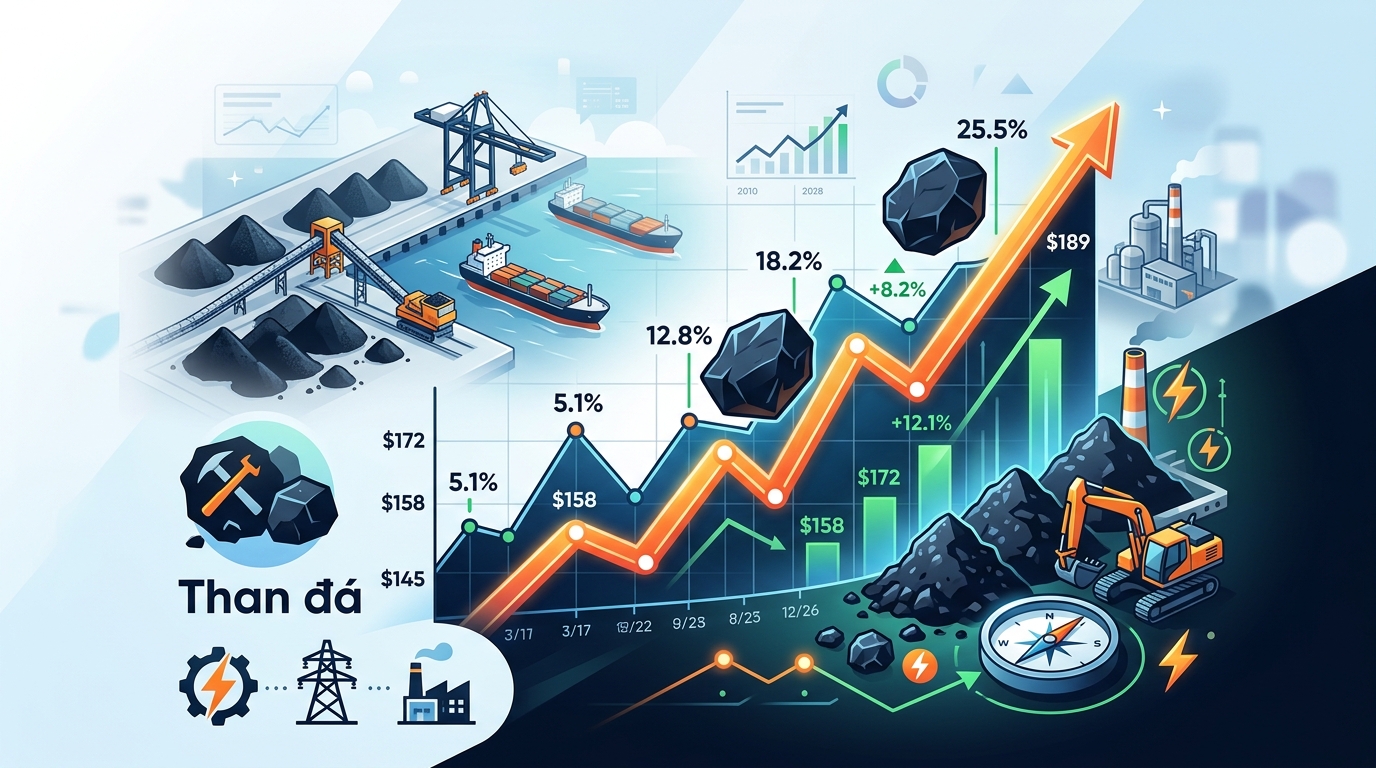
Entering the first days of July 2026, the global energy market in general and the coal market in particular are witnessing highly notable developments. Following a period of significant volatility in the second quarter, especially in June, coal prices are currently showing signs of leveling off and establishing a new support zone. This article provides a detailed analysis of the price situation, the causes of volatility, and the macroeconomic impacts affecting this "black gold" commodity during the period from July 1 to July 31, 2026.
1. Overview of coal price developments in July 2026
According to the latest updated data from the market monitoring system, as of July 6, 2026, global coal prices are trading at 128.80 USD/mt, equivalent to approximately 3,387,041 VND/ton. Compared to the previous trading session, the price of coal fluctuated only slightly with an increase of +0.23% (corresponding to an increase of 0.30 USD or approximately 7,889 VND).
The most notable point in the current price landscape is the significant decline compared to the previous month's average. Specifically:
- Average price in June 2026: 145.29 USD/mt (approximately 3,820,677 VND/ton).
- Average price in July 2026 (to date): 129.07 USD/mt (approximately 3,394,141 VND/ton).
- Fluctuation range over the past 30 days: From 128.80 USD to 151.25 USD/mt.
Looking at the daily data series since the beginning of July, we see a clear trend of stability. During the first two days of the month (July 1 and July 2), prices anchored at 129.60 USD/mt. From July 3 to July 6, prices decreased slightly and maintained stability at the 128.80 USD/mt mark. This is a signal that the market has absorbed the supply shocks from the previous month and is finding a new equilibrium point amidst a slowdown in industrial demand.
2. Analysis of the causes of coal price volatility
The decline in coal prices from a peak of over 151 USD to around the 128 USD threshold within a month is not coincidental. There are three main groups of causes leading to this correction:
2.1. Recovery of global supply
Following disruptions due to weather and logistics factors in major exporting countries like Australia and Indonesia in the second quarter, mining output began to stabilize at the beginning of July. Large coal mines in Queensland (Australia) have restored full capacity, helping to relieve the pressure of supply shortages in the spot market. This increase in supply has directly pulled the average coal price down from the previous month's level of 145.29 USD to the current level.
2.2. Cooling demand for reserves in China and India
China and India, the world's two largest coal consumers, completed large-scale coal stockpiling for the summer peak from May and June. Entering July, reserves at ports and power plants in these countries reached safe levels. As the demand for new purchases eased, pressure on international coal prices immediately cooled, causing prices to enter a stable trajectory around the 128-129 USD/mt threshold.
2.3. Competition from alternative energy sources
July 2026 recorded a boom in renewable energy (solar and wind power) in regions such as Europe and North America due to favorable weather conditions. This reduced reliance on coal-fired power plants, leading to a decline in coal consumption for power generation on a global scale. This is one of the factors curbing the upward price momentum, keeping the change at a low level of +0.23%.
3. Analysis of macroeconomic influences on coal prices
Coal prices are not only affected by direct supply and demand laws but are also strongly influenced by global macroeconomic factors. During July 2026, the following factors played a key role:
3.1. Monetary policy and exchange rates
Coal is a commodity priced in USD. Therefore, any fluctuation in the US Dollar Index (DXY) directly affects coal prices when converted into the local currencies of importing countries. In the first week of July, the relative stability of the USD helped coal prices maintain at 128.80 USD without a spike. For Vietnam, this price is equivalent to approximately 3.38 million VND/ton, an acceptable price level for domestic power and cement production enterprises.
3.2. Global economic growth and manufacturing activity
The Purchasing Managers' Index (PMI) in major economies is showing a slowdown in manufacturing growth. When industrial activity is no longer overheated, the demand for input energy, especially coal for metallurgy and chemicals, also decreases accordingly. This explains why this month's average price is significantly lower (a decrease of about 11%) compared to June.
3.3. Green energy transition trend
By 2026, carbon tax regulations and Net Zero commitments began to take effect more strongly in many countries. International financial institutions are increasingly tightening capital flows for new coal mining projects. In the short term, this may cause supply scarcity (driving prices up), but in the medium term, as is currently the case, it encourages businesses to switch to using natural gas or renewable energy, reducing the total demand for coal.
4. The coal market in Vietnam: Opportunities and Challenges
In Vietnam, stable global coal prices at 128.80 USD/mt bring mixed impacts. Vietnam is currently a large coal importer to serve thermal power plants and industrial production.
On the positive side: The decrease in coal prices from an average of 3.82 million VND/ton (in June) to 3.39 million VND/ton (in July) helps reduce input cost pressure for Vietnam Electricity (EVN) and steel and cement production enterprises. This contributes significantly to stabilizing the Consumer Price Index (CPI) and controlling domestic inflation.
On the challenge side: Although global prices have decreased, logistics and shipping costs in 2026 remain high due to geopolitical fluctuations on key shipping routes. Therefore, the actual landed price of coal in Vietnam may still be higher than the listed price on the international market. Domestic enterprises need to closely monitor the 30-day price range (128.80 - 151.25 USD) to make decisions on closing import contracts at favorable price points.
5. Assessment and forecast for the next period of July 2026
Based on actual data and macroeconomic analysis, we offer some assessments for the coal market in the remaining weeks of July:
- Price trend: Coal prices are likely to continue moving sideways within a narrow range of 125 - 132 USD/mt. It will be difficult to see sharp price shocks unless there are unusual natural disasters in major mining regions.
- Factors to watch: Weather conditions in East Asia. If record-breaking prolonged heatwaves occur, electricity demand for cooling will skyrocket, forcing coal-fired power plants to operate at full capacity, in which case coal prices could return to the 135 - 140 USD/mt threshold.
- Advice for businesses: With the current price (128.80 USD) at its lowest level in the past 30 days, this is an appropriate time for businesses with high coal consumption needs to consider signing forward purchase contracts to optimize production costs for the third and fourth quarters of 2026.
In summary, July 2026 is bringing a breath of fresh air to the coal market with necessary stability and cooling. Although pressures from environmental policies and macroeconomic fluctuations remain, the price level around 129 USD/mt is creating a good foundation for global industrial production activities in general and Vietnam in particular. Timely grasping of market information and understanding the causes of volatility will be the key to helping investors and businesses adapt effectively in the current volatile energy market context.
Information summarized and assessed based on market data as of July 6, 2026. Further developments will be continuously updated in our upcoming periodic reports.