 Deutsch
  English
  Español
  Français
  Bahasa Indonesia
  日本語
日本語  한국어
한국어  Nederlands
  Português
  Tiếng Việt
  中文
中文 Coal Market August 2026: Slight Fluctuations Amid Global Stability
AI Report · Coal
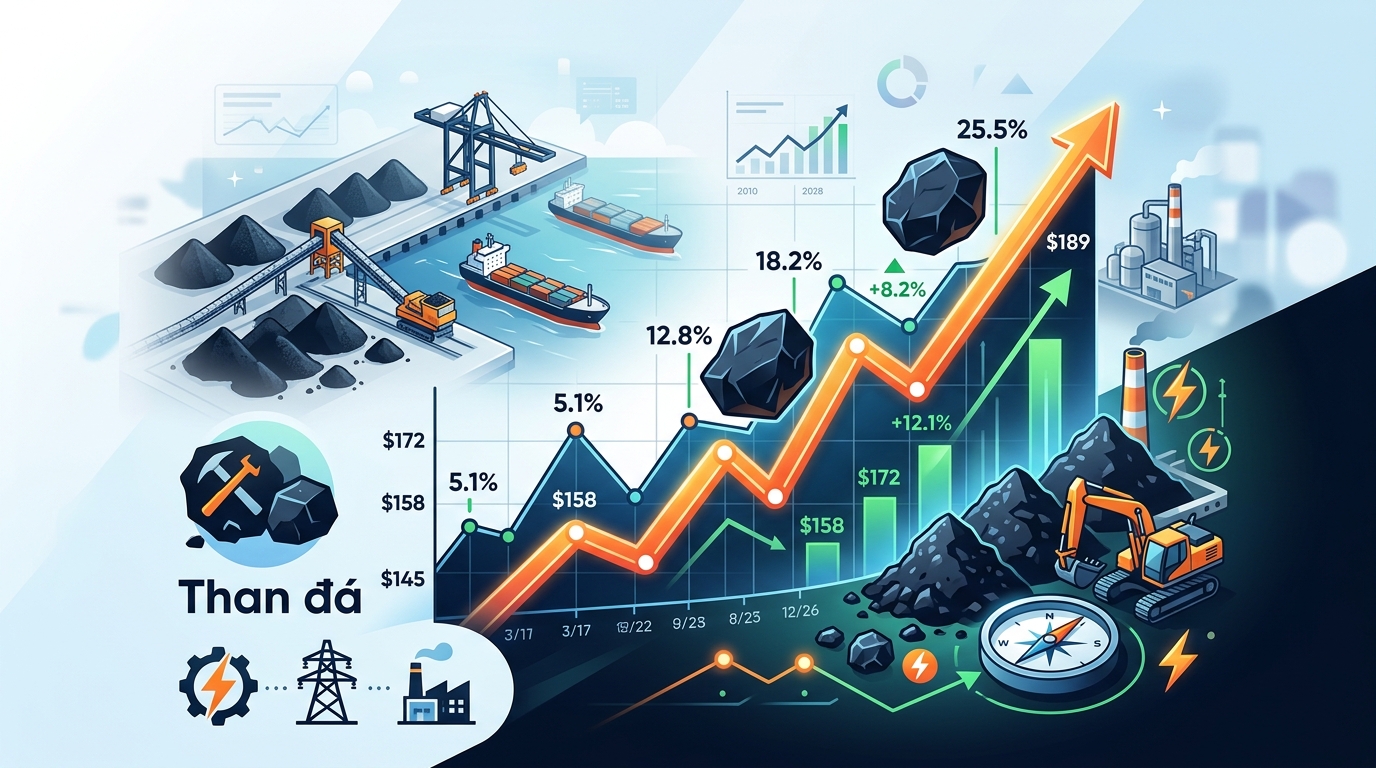
August 2026 began with mixed signals in the global fossil fuel energy market. Following a period of high volatility in the second quarter, the coal market is gradually finding a new equilibrium. This article provides a detailed analysis of coal price movements during the first week of August 2026, the core drivers behind these price changes, and the significant macroeconomic impacts on the coal markets in Vietnam and worldwide.
1. Overview of Coal Price Movements in the First Week of August 2026
Based on actual data from energy trading systems, global coal prices in the early days of August 2026 are maintaining a high average compared to the same period last year, though there are signs of a slight correction toward the end of the week. Specifically, as of August 6, 2026, the spot coal price was recorded at 128.80 USD/mt (equivalent to approximately 3,384,645 VND/ton).
Looking back at the trends since the beginning of the month, we observe a slight decline from the short-term peak:
- August 1 - August 2: Prices maintained the monthly high of 134.00 USD/mt.
- August 3: Prices began to adjust downward to 132.50 USD/mt.
- August 4: Continued to decline to 130.85 USD/mt.
- August 5 - August 6: Prices leveled off and stabilized at 128.80 USD/mt.
Despite the slight decline in recent days, when compared to the general landscape, the current average price for August (131.49 USD) remains higher than the July average (129.67 USD). This indicates a slight growth trend of approximately +1.57%, reflecting that market sentiment is still supported by fundamental supply and demand factors.
2. Analysis of Factors Driving Price Fluctuations in This Period
The decline from 134.00 USD to 128.80 USD in less than a week is not a collapse, but a necessary "technical correction" following a period of rapid growth. There are three main reasons for this fluctuation:
Saturation of Thermal Power Plant Stockpiles
At the end of July, major coal-consuming nations like China and India ramped up imports to cope with the summer heat peak. As inventories at power plants reached capacity (inventory build-up), the pressure to buy on the spot market eased, leading to a cooling of prices in the first week of August.
Stabilization of Supply from Indonesia and Australia
Following minor weather-related disruptions last month at open-pit mines in Kalimantan (Indonesia), export volumes have recovered strongly. The influx of abundant supply into the Asian market has helped alleviate shortage concerns, pushing prices from the 134 USD level to a more stable range around 128 USD.
Competition from Alternative Energy Sources
During the first week of August 2026, the price of liquefied natural gas (LNG) trended slightly downward due to increased production in the U.S. This prompted some power plants in Europe and Northeast Asia to shift part of their capacity from coal to gas, reducing direct demand pressure on coal.
3. Macroeconomic Influences on Global Coal Prices
Coal prices do not fluctuate solely based on supply and demand laws but are also deeply affected by macroeconomic factors and global politics:
Monetary Policy and the USD Exchange Rate
Coal is denominated in USD. During August 2026, expectations regarding interest rate adjustments by the U.S. Federal Reserve (Fed) are exerting pressure on exchange rates. As the USD maintains its strength, the cost of importing coal for developing nations like Vietnam becomes more expensive, even if the listed market price decreases. The current price of 128.80 USD/mt, when converted to VND, has exceeded the 3.38 million VND/ton threshold, putting pressure on input costs for the power and steel industries.
Geopolitical Conflicts and Supply Chains
Tensions along vital maritime routes remain a "ticking time bomb" for energy prices. High freight rates due to security risks force coal traders to add insurance premiums to the final selling price, causing the price range over the past 30 days to fluctuate widely, from 127.70 to 134.00 USD.
Climate Change Commitments (Net Zero)
Strict carbon tax regulations in Europe are gradually spreading to other regions. This creates a divergence: high-calorific coal (with lower emissions) maintains good pricing, while lower-quality coal faces strong downward pressure due to declining demand from countries undergoing green transitions.
4. Vietnam's Coal Market: Challenges and Opportunities
In Vietnam, the coal market in August 2026 is in a state of "observation and adaptation." As a country that both produces and imports large volumes of coal, global price fluctuations directly impact the domestic economy.
Regarding domestic production: The Vietnam National Coal and Mineral Industries Group (TKV) and the Dong Bac Corporation are striving to maintain extraction output to ensure energy security. However, due to increasingly deep mining conditions, domestic production costs are trending upward, approaching the price of imported coal.
Regarding imports: The stabilization of global coal prices at 128.80 USD/mt is a relatively positive signal for BOT thermal power plants and steel mills. While this price is higher than the historical average, it remains within the planned budget framework for many businesses. However, the gap between last month's average (129.67 USD) and this month's (131.49 USD) shows that cost pressures remain present.
Impact on the power industry: August remains the end of the dry season in the South and the beginning of the rainy season in the North. Dependence on coal-fired power remains very high as hydropower has not yet reached maximum capacity. Therefore, the 1.57% increase in coal prices could affect electricity production costs, posing a balancing challenge for the national power sector.
5. Outlook and Forecast for the Remainder of August 2026
Based on available data, we offer the following outlook for the coal market in the coming weeks of August 2026:
- Price Trend: Coal prices are expected to continue moving sideways within a narrow range of 125 - 132 USD/mt. A sudden price spike is unlikely unless there is an unexpected supply disruption from major mines in Australia or extreme political volatility.
- Demand: Demand from China may decline slightly as the country moves toward the end of summer, but demand from India is expected to rise in preparation for the festival season and the recovery of industrial production after the monsoon.
- Advice for Businesses: Large coal-consuming enterprises in Vietnam should take advantage of price corrections toward the 127-128 USD range to lock in spot contracts to optimize input costs, avoiding the wait-and-see mentality for deeper price drops, as the 125 USD support level is proving very solid.
Conclusion
The coal market for the week of August 1 to August 31, 2026, presents a picture of stability amidst high prices. With the current price of 128.80 USD/mt, the market has fully reflected existing risk factors. Although the long-term trend remains a shift toward renewable energy, in the short term, coal continues to play a "backbone" role for global and Vietnamese energy security.
Closely monitoring macroeconomic indicators such as the U.S. Dollar Index (DXY) and coal inventory reports at major ports will help investors and businesses gain a more accurate perspective to make appropriate business decisions in an energy market still full of unknowns.
Summarized and analyzed by the Energy Market Analysis Board.