 Deutsch
  English
  Español
  Français
  Bahasa Indonesia
  日本語
日本語  한국어
한국어  Nederlands
  Português
  Tiếng Việt
  中文
中文 Beef Market July 2026: A Stable Anchor and Macro Challenges from the Global Supply Chain
AI Report · Beef
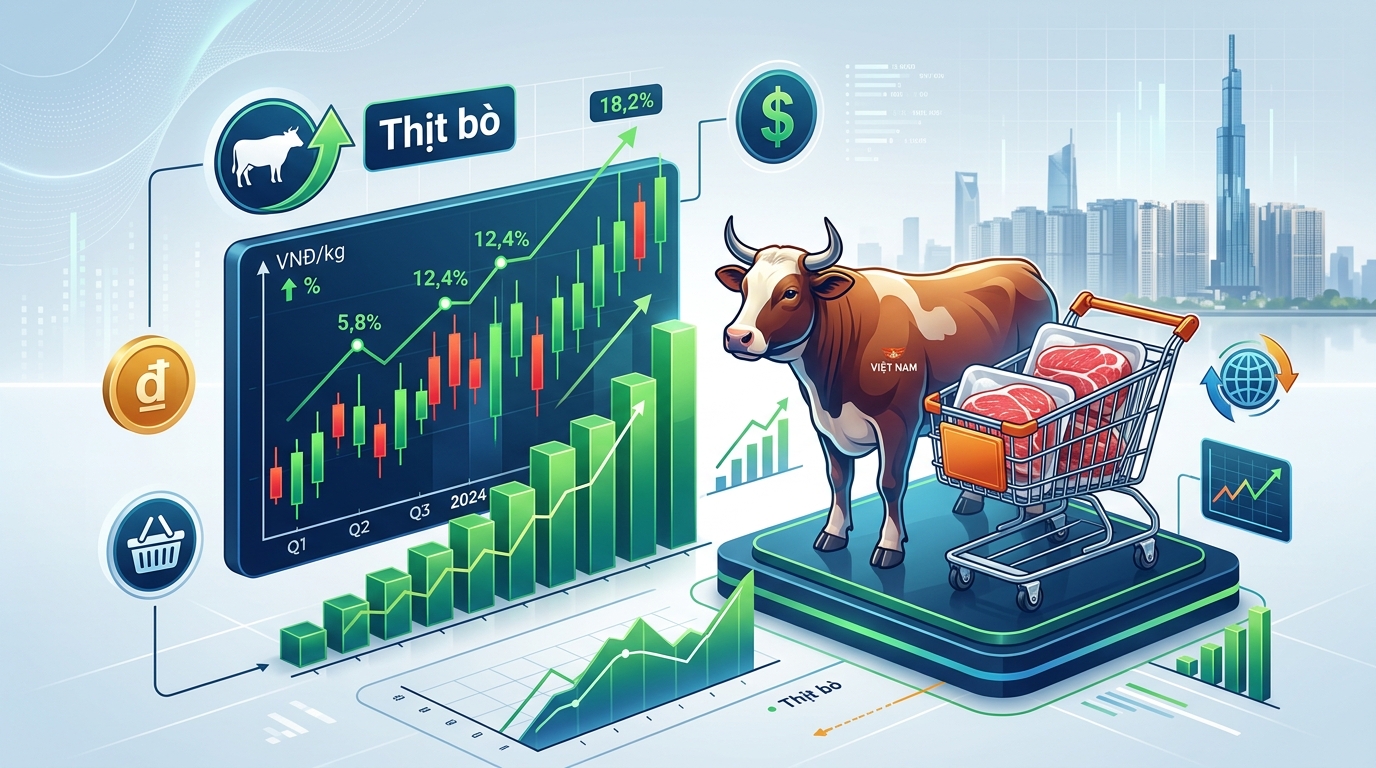
Entering the third quarter of 2026, the global food market in general and the beef industry in particular are witnessing interesting developments. After a period of high volatility in the first half of the year, data recorded as of July 1, 2026, shows a signal of slight recovery but with high stability. This article will delve into the analysis of actual figures, provide insights into price trends in Vietnam and the world, and dissect the macro factors reshaping this multi-billion dollar industry during the period from July 1, 2026, to July 31, 2026.
1. Overview of the beef price landscape at the beginning of July 2026
Based on the latest market data, global beef prices (referenced from the Brazilian market—one of the largest beef exporters on the planet) stand at 336.40 BRL/kg as of July 1, 2026. This price is equivalent to approximately 1,389,776,048 VND/ton when converted into Vietnamese Dong.
Looking at short-term developments, the market recorded a slight growth of +0.66%, corresponding to an increase of 2.25 BRL (approximately 9,295,470 VND/ton) compared to the previous trading session. However, when placed in the broader context of the past 30 days, we see a significant correction. The average price of the previous month reached 347.93 BRL, while the fluctuation range in the last 30 days was between 336.40 - 353.80 BRL.
This indicates that despite a slight upturn at the beginning of July, current beef prices are still at the lowest level in the past 30-day cycle. The current trend is assessed by experts as "stable," signaling a period of accumulation following the price drop from the high threshold of over 350 BRL/kg.
2. Analysis of the causes of price fluctuations in July 2026
Beef price fluctuations are never random; they are the result of a complex interaction between global supply and demand. There are three main groups of causes leading to the current low-level stability:
- Abundant supply from South American countries: Brazil and Argentina, after a period of strong herd rebuilding in 2024-2025, have now reached peak export production. The abundant supply to the international market has created significant downward pressure on prices compared to the same period last year, causing this month's average price to be nearly 11 BRL/kg lower than the previous month.
- Recovery of the logistics chain: After minor disruptions in maritime transport in early 2026, major shipping routes from South America to Asia have returned to smooth operation. Reduced freight costs help ensure that the price of imported beef arriving at ports in Vietnam and China is no longer excessively inflated.
- Cautious sentiment among importers: With prices fluctuating in the 336.40 - 353.80 BRL range, major food businesses are tending to buy moderately to observe the market, rather than stockpiling large quantities. This keeps prices from being pushed up too quickly, despite slight increases like the one on July 1.
3. Beef market situation in Vietnam
In Vietnam, domestic beef prices are always closely linked to global prices because the proportion of imported beef (especially cattle from Australia and frozen beef from Brazil and India) accounts for a significant part of the consumption structure.
Regarding retail prices: At traditional markets and major supermarket chains such as WinMart, Co.op Mart, or GO!, beef prices in the first week of July 2026 are expected to remain flat. Domestic beef tenderloin fluctuates from 260,000 - 290,000 VND/kg, while imported beef brisket from Brazil is priced more affordably, around 160,000 - 190,000 VND/kg, thanks to taking advantage of the downward trend in the global market (the 1.38 billion VND/ton figure is the wholesale/export price at the source).
Regarding domestic livestock farming: Beef cattle farmers in Vietnam are facing major challenges as domestic live cattle prices struggle to compete with cheap imported beef. However, the "hot beef" segment (fresh meat processed on the day) still retains market share thanks to Vietnamese consumption habits. Concentrated livestock farms in Gia Lai, Nghe An, and Dong Nai are striving to optimize feed costs to maintain profit margins in the context of low global prices.
4. Macro influences on global beef prices
To understand why beef prices are at 336.40 BRL/kg and trending toward stability, we need to look at the macro factors affecting the entire industry:
4.1. Exchange rate fluctuations
The Brazilian Real (BRL) against the USD and VND plays a key role. The conversion price reaching over 1.38 billion VND/ton reflects part of the strength of the local currency in international transactions. If the USD weakens, the price of commodities denominated in other currencies tends to rise slightly, explaining the 0.66% increase on July 1. However, the stability of the exchange rate during this period is an "anchor" that prevents beef prices from experiencing price shocks.
4.2. Environmental policies and ESG standards
By 2026, strict regulations on anti-deforestation (such as the European Union's EUDR) have been fully implemented. Beef-exporting countries like Brazil must prove that their products are not linked to the destruction of the Amazon rainforest. The costs of complying with these standards have been reflected in production costs, creating a "support threshold" that makes it difficult for prices to fall deep below the 330 BRL/kg level.
4.3. Input material prices (Animal feed)
Corn and soybean prices on the Chicago Board of Trade (CBOT) in the second quarter of 2026 were quite stable thanks to a favorable harvest season in North America. This is an important factor in lowering the cost of cattle farming at feedlots, thereby indirectly curbing the upward momentum of finished beef prices in the market.
4.4. Disease situation and food safety
Good control of Foot-and-Mouth Disease (FMD) and Bovine Spongiform Encephalopathy (BSE) on a global scale in 2025 and early 2026 has created confidence for consumers. When there are no trade embargoes related to diseases, the flow of goods proceeds smoothly, helping the market maintain a state of stability rather than extreme volatility.
5. Assessment and forecast for the period July 1 - July 31, 2026
Based on technical and fundamental analysis, we provide the following assessments for the beef market throughout July 2026:
First, the price trend will continue to move sideways within a narrow range. The 336.40 BRL price level can be considered a temporary bottom. Trading sessions in July may record corrections up to the 340 - 345 BRL level, but it is difficult to exceed the 350 BRL threshold unless there are unexpected political events or natural disasters.
Second, consumer demand in the Asian region, especially in China and Vietnam, is expected to increase slightly at the end of July in preparation for festivals and the peak summer travel season. This will support prices from falling further, even though supply from South America remains very large.
Third, global food inflation pressure is showing signs of cooling down. This allows households to loosen their spending, helping purchasing power for high-end food items like beef to be more stable compared to the 2024-2025 period.
6. Advice for businesses and consumers
For import and distribution businesses: This is an appropriate time to lock in medium-term contracts while prices are at their lowest level in 30 days (336.40 BRL). Taking advantage of this cycle's "bottom" price will help businesses optimize their cost of goods sold for the year-end business period.
For consumers: Beef prices in the Vietnamese market in July 2026 will be very affordable. This is an opportunity to add high-quality protein to family menus without worrying too much about costs. However, priority should be given to choosing products with clear origins that ensure food safety and hygiene standards.
Conclusion: The beef market in July 2026 is showing a balanced and stable face. Despite minor daily fluctuations like the recent 0.66% increase, in general, the market has established a new price floor that is more reasonable for both producers and consumers. Macro factors, from exchange rates to environmental policies, will continue to be the "compass" regulating prices in the coming time, promising a more sustainable food market in the future.