 Deutsch
  English
  Español
  Français
  Bahasa Indonesia
  日本語
日本語  한국어
한국어  Nederlands
  Português
  Tiếng Việt
  中文
中文 Beef Market in August 2026: Pressure from Input Costs and a Trend of High-Level Stability
AI Report · Beef
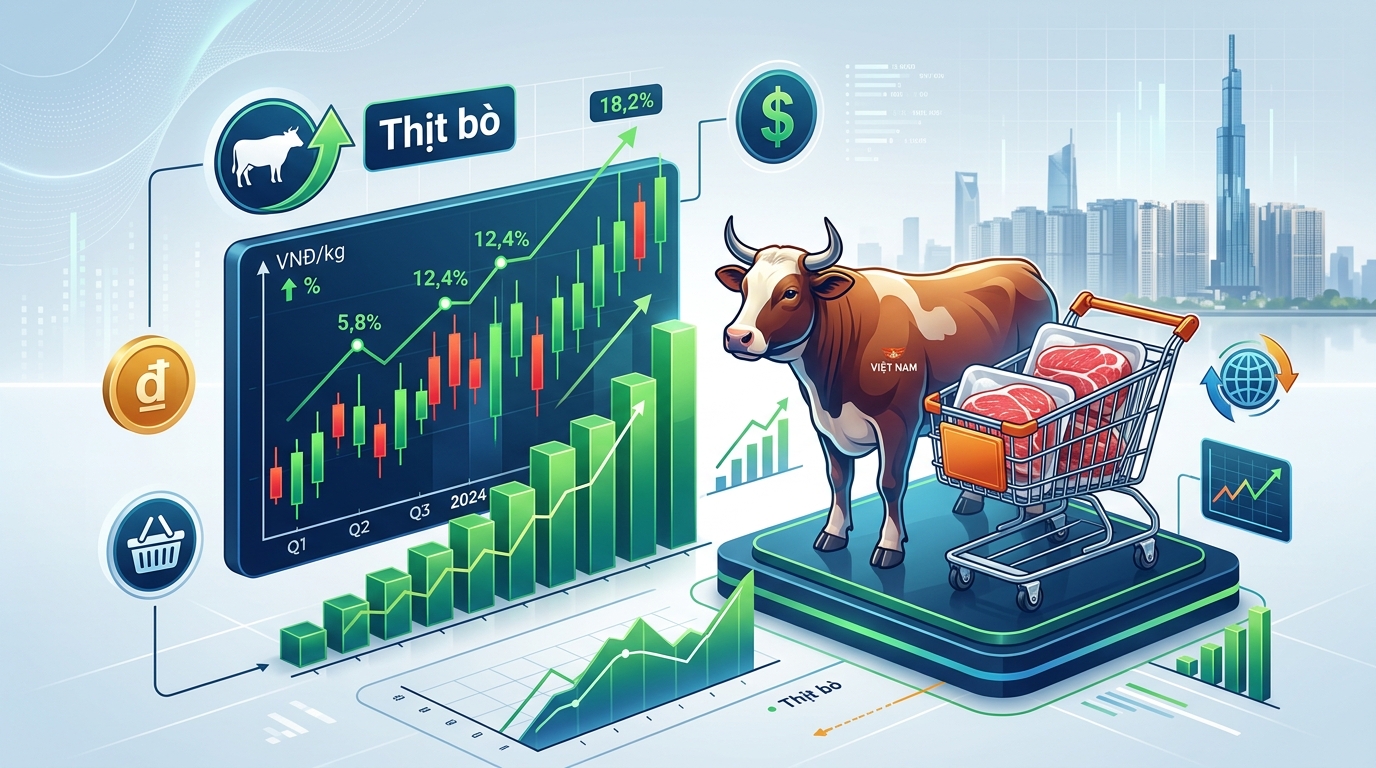
Overview of beef market developments in early August 2026
Entering August 2026, the global beef market is showing signals of a trend characterized by stability alongside a significant increase in value compared to previous months. Based on actual data from the international market, particularly in key exporting nations like Brazil, beef prices are establishing a new price floor, significantly higher than the same period last year and the previous month.
As of August 1, 2026, the price of beef was recorded at 346.55 BRL/kg (equivalent to approximately 1,431,708,946 VND/ton). Compared to the previous trading session, this price fluctuated only slightly with an increase of +0.1%, corresponding to a difference of +0.35 BRL (approximately +1,445,962 VND/ton). However, looking at the broader picture, we see a clear shift. The current monthly average price (346.55 BRL) has risen sharply compared to the average price in July 2026 (334.98 BRL), indicating that underlying upward price pressure persisted throughout the previous month and began to crystallize at the start of August.
The fluctuation range over the past 30 days has been between 324.60 and 347.70 BRL/kg. The fact that the current price is anchored near the peak of this range (346.55 BRL) demonstrates that supply is tightening or consumption demand remains very high, preventing the market from undergoing significant downward corrections.
Analysis of the causes of beef price fluctuations
The volatility of beef prices during August 2026 is not a random phenomenon but the result of a combination of factors ranging from the supply chain to production costs.
1. Livestock cycle and supply
The global beef industry, especially in powerhouses like Brazil, the US, and Australia, is in a herd-rebuilding phase following production declines due to natural disasters and diseases in previous years. Retaining cows for breeding instead of sending them to slaughter has reduced the short-term supply of commercial beef to the market. This has pushed beef prices higher and kept them at the stable levels observed in our early August report.
2. Feed costs remain high
Although global grain prices (corn, soybeans) have experienced cooling periods, logistics costs and animal feed additives remain high because global inflation has not been fully controlled. The input costs to raise a cow to slaughter age in 2026 have increased by approximately 15-20% compared to the 2024-2025 period, forcing producers to adjust selling prices to maintain profit margins.
3. Domestic and export consumption demand
August is typically a time when beef consumption demand in Southern Hemisphere countries increases due to festivals and tourism activities. In Brazil, our primary reference country, export demand to major markets such as China and the Middle East continues to maintain strong growth momentum, creating competition for supply between the domestic and export markets, thereby pushing the BRL/kg price to record highs.
Vietnam Market: Spillover effects from global prices
In Vietnam, beef prices in August 2026 are directly influenced by global market fluctuations, particularly in the segment of imported beef from Australia, the US, and Brazil. With global prices at approximately 1.43 billion VND/ton (raw price excluding taxes, shipping fees, and retail margins), beef prices at domestic wholesale markets and supermarkets have also recorded corresponding adjustments.
- Imported beef: Importers are facing double pressure: rising costs in the country of origin and sea freight costs that show no signs of deep decline. This keeps imported beef firmly in the premium segment, with retail prices ranging from 250,000 to 450,000 VND/kg depending on the cut.
- Domestic beef: Although domestic supply has improved thanks to large-scale farms, domestic beef prices must still adjust to the general trend to offset the costs of imported industrial feed. Vietnamese consumers are tending to tighten spending, prioritizing moderately priced beef cuts or switching to alternative proteins such as pork and poultry.
Macroeconomic influences on beef prices in August 2026
To better understand why beef prices are anchored at 346.55 BRL/kg, we need to analyze the macroeconomic variables impacting the global economy.
1. Exchange rate fluctuations
The Brazilian Real (BRL) plays a key role in pricing beef on international exchanges. During August 2026, the volatility of the BRL/USD exchange rate directly affected the revenue of exporters. When the BRL tends to stabilize or appreciate slightly against the USD, beef prices in BRL terms tend to move sideways or rise to ensure that the converted value in foreign currency does not decline. For Vietnam, the USD/VND exchange rate is also an important variable, affecting the final cost of imported beef upon arrival at Cat Lai or Hai Phong ports.
2. Environmental policy and ESG
The year 2026 marks new steps in the application of strict environmental regulations for the livestock industry. EU countries and several US states have begun imposing carbon taxes or requiring deforestation-free certificates (EUDR) for imported beef. Compliance with these regulations incurs additional costs for inspection and traceability, directly pushing up product costs globally.
3. Geopolitics and logistics
Local conflicts in several key regions are affecting international shipping routes. Extended transit times and increased cargo insurance premiums have contributed to keeping beef prices high. Although the trend is "stable," this is stability at a price ceiling, where all intermediary costs have already been factored into the retail price.
Assessment and Forecast for the next period
Based on available data, we believe that beef prices throughout August 2026 will continue to maintain a state of "stability within an upward trend." The 0.1% increase at the beginning of the month is the first shot indicating that the market is testing new resistance levels.
Short-term forecast: From now until the end of August, it is unlikely that beef prices will fall below 340 BRL/kg. Conversely, if reports on US inventories or demand from China increase sharply, prices could challenge the 350 BRL/kg threshold.
Advice for stakeholders:
- For importers: It is necessary to closely monitor exchange rate fluctuations and information on export quotas from Brazil to have appropriate order-locking strategies, avoiding price shocks at the end of the quarter.
- For domestic farmers: This is a good time to optimize farming processes and reduce dependence on imported feed to take advantage of market gaps while foreign beef prices are high.
- For consumers: It is advisable to plan spending reasonably; consider frozen beef products or less popular cuts to save costs while still ensuring nutrition.
Conclusion
The beef market in August 2026 reflects a new reality of the global agricultural economy: higher costs and stricter regulations, yet persistent demand. The price of 346.55 BRL/kg is not just a number, but an expression of a supply chain striving to balance profit with market affordability. Understanding the macroeconomic impacts and the root causes of price fluctuations will help Vietnamese businesses and consumers make sound decisions during this challenging period.
This report is compiled based on actual market data as of August 1, 2026. Further developments will be updated continuously in our upcoming newsletters.