 Deutsch
  English
  Español
  Français
  Bahasa Indonesia
  日本語
日本語  한국어
한국어  Nederlands
  Português
  Tiếng Việt
  中文
中文 Cocoa Market in July 2026: Prices Maintain High Threshold Amid Tight Supply and New Regulatory Pressures
AI Report · Cocoa
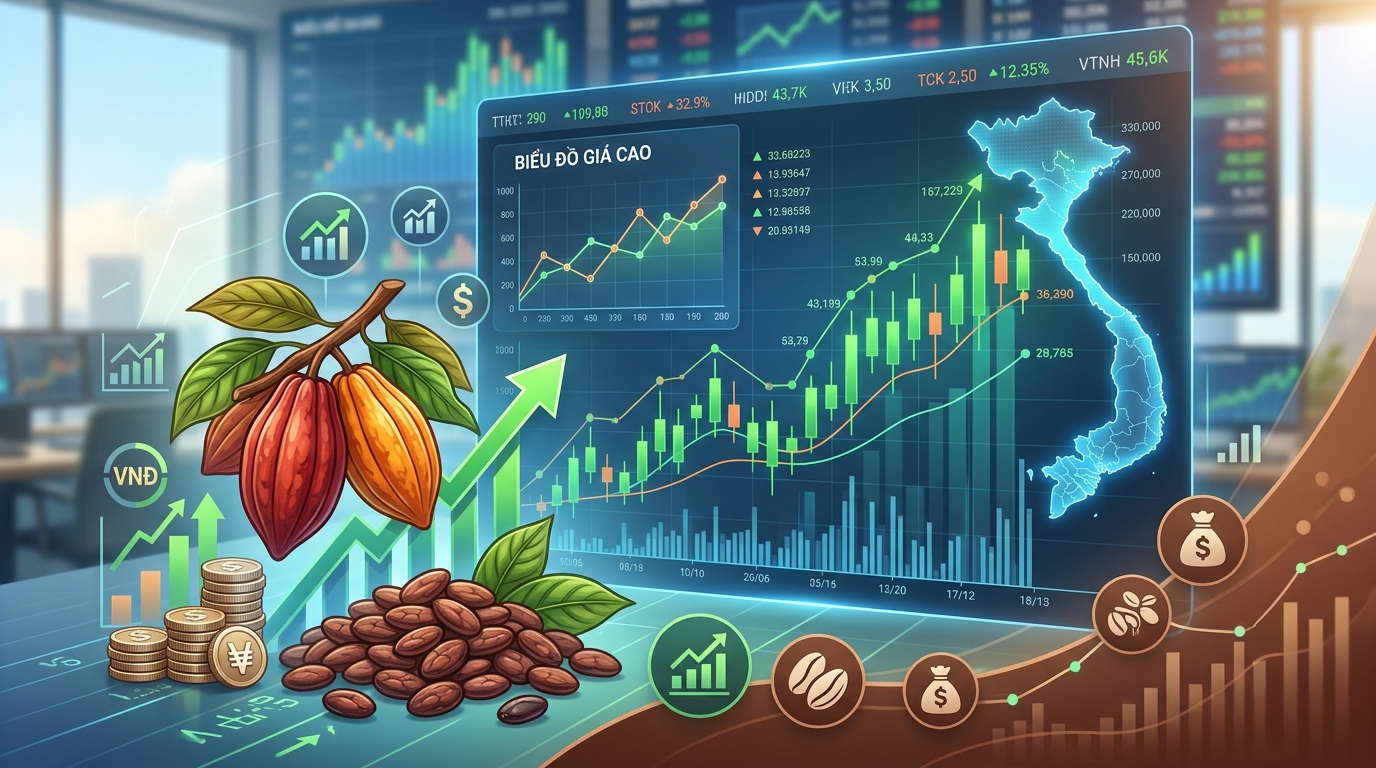
Entering the first days of July 2026, the global agricultural market in general and the cocoa sector in particular are witnessing dramatic developments. Following a period of high volatility in the first half of the year, cocoa prices are currently establishing a new price floor, reflecting profound changes in the global supply-demand structure. This article provides a detailed analysis of the cocoa price situation in Vietnam and globally for the week of July 1, 2026, to July 31, 2026, while dissecting the macroeconomic and microeconomic factors shaping market trends.
1. Overview of Cocoa Prices Updated for the First Week of July 2026
Based on the latest market data as of July 4, 2026, cocoa prices are maintaining a level of 5,036.00 USD/mt. This is a notable figure, indicating that the value of this "black gold" remains anchored at a high level compared to the historical averages of many previous years.
- Current Price: 5,036.00 USD/mt (equivalent to approximately 132,431,188 VND/ton).
- Trend: Stable with a slight increase of +1.1% compared to the previous trading session.
- Absolute Change: Increase of 56.00 USD (equivalent to approximately 1,472,626 VND/ton).
- 30-Day Price Range: Fluctuating from 0.00 to 5,230.00 USD/mt.
Looking at the daily price movements in the first week of July, we see a slight recovery after a quiet July 1:
- July 1, 2026: The market recorded 0.00 USD (likely due to a holiday or early-month data adjustment).
- July 2, 2026: Price reached 5,017.00 USD/mt.
- July 3, 2026, and July 4, 2026: Prices stabilized at 5,036.00 USD/mt.
A noteworthy point is that the current monthly average price (3,772.25 USD) is still lower than the previous month's average (4,276.37 USD). However, the actual price as of July 4 has far exceeded this average, indicating a strong upward price wave occurring right in the first days of July, pushing prices past the psychological resistance level of 5,000 USD/mt.
2. Cocoa Market Situation in Vietnam
In Vietnam, domestic cocoa prices are closely linked to the London and New York exchanges. With global prices at approximately 132.4 million VND/ton, the purchase price for fermented dried cocoa beans in key production regions such as Dak Lak, Lam Dong, Ben Tre, and Tien Giang is also at a multi-year record high.
Farm-gate Purchase Price: Currently, cocoa purchasing and exporting companies in Vietnam are adjusting their buying prices to align with the global upward trend. This brings great joy to farmers but also poses challenges for domestic chocolate manufacturers as input material costs skyrocket.
Quality and Positioning: Vietnamese cocoa is highly regarded for its "Fine Flavor." Amidst supply difficulties from West Africa, international buyers are tending to seek more stable alternative sources, and Vietnam is one of the potential destinations despite its modest output.
3. Analysis of Factors Causing Price Volatility in July 2026
The 1.1% increase in the first days of the month and the maintenance of prices above 5,000 USD/mt are not coincidental. There are three main groups of causes leading to this situation:
3.1. The Unending Supply Crisis in West Africa
Ivory Coast and Ghana, two countries accounting for over 60% of global cocoa production, continue to face serious challenges. Reports in July 2026 show that diseases on cocoa trees (such as swollen shoot and black pod disease) along with the aging of plantations have reduced actual harvest yields compared to forecasts. Although weather conditions have improved somewhat compared to the harsh El Niño years of 2024-2025, the recovery capacity of the crops requires more time than expected.
3.2. Pressure from the EU's EUDR Regulation
By July 2026, the EU Deforestation Regulation (EUDR) has entered a strict enforcement phase. Cocoa imported into Europe must be proven to be unrelated to deforestation after 2020. The establishment of costly and complex traceability systems has made "clean cocoa" supply scarce, pushing the prices of compliant shipments to very high levels.
3.3. Speculative Sentiment and Stockpiling by Major Producers
After the price shocks of 2024-2025, major global confectionery corporations have changed their strategies. Instead of buying "spot," they have increased forward purchases and warehouse stockpiling to secure supply chains. This action inadvertently creates a permanent demand force in the market, keeping prices from falling deeply even when selling pressure emerges at times.
4. Macroeconomic Influences on Cocoa Prices
Cocoa prices are not only affected by pure commodity supply and demand but are also strongly influenced by global macroeconomic factors in mid-2026.
4.1. Exchange Rate Fluctuations and USD Strength
Cocoa is priced in USD on international exchanges. In the first week of July 2026, the stability of the USD against other major currencies helped cocoa prices maintain their upward momentum without being dragged down by exchange rate pressures. For Vietnam, the high USD/VND exchange rate causes both the import cost of cocoa machinery and the export price of beans to increase when converted into local currency.
4.2. Logistics and Shipping Costs
Although global supply chain congestion has cooled compared to the previous period, sea freight costs remain anchored at high levels due to rising Green Fuel prices in line with carbon emission reduction commitments. Cocoa is a high-volume commodity, so shipping costs account for a significant proportion of the final cost at consumption ports such as Amsterdam or Hamburg.
4.3. Central Bank Interest Rate Policies
In July 2026, the market is closely monitoring the moves of the US Federal Reserve (Fed) and the European Central Bank (ECB). Interest rates maintained at high levels to curb inflation have increased financial costs for traders holding large long positions on futures exchanges. This sometimes causes strong shocks when investment funds adjust their portfolios to optimize cash flow.
5. Outlook and Forecast for the Next Phase of July 2026
With the current price of 5,036.00 USD/mt, the market is in a state of "high-altitude equilibrium." Below are the outlooks for the following weeks of July:
Optimistic Scenario: If reports on mid-crop harvest yields in West Africa continue to be lower than expectations, cocoa prices could fully test the 5,230.00 USD/mt threshold (the highest level in the past 30-day range). Local supply shortages will be the main driver of this upward momentum.
Stable Scenario: Prices will move sideways in the 4,800 - 5,100 USD/mt range. This is the most likely scenario as manufacturers have completed purchases for the third quarter and the market awaits new weather signals for the upcoming main crop.
Advice for Stakeholders:
- For farmers: This is a golden time to invest in orchard care and apply sustainable farming standards to meet EU market requirements, in order to enjoy higher premiums.
- For exporters: Be cautious in signing long-term delivery contracts without hedging measures, as the market's current volatility range remains very large.
- For investors: Cocoa remains a commodity with attractive liquidity and volatility, but it is necessary to closely monitor inventory reports at exchanges to avoid short-term price traps.
Conclusion
The cocoa market in the first week of July 2026 reflects a new reality: The era of cheap cocoa has ended. With prices around the 132 million VND/ton threshold, cocoa is asserting its position as one of the most valuable agricultural commodities. The combination of natural factors (disease, weather) and artificial factors (EUDR regulations, monetary policy) has created a challenging market that also opens up many opportunities for producing countries with well-structured strategies like Vietnam.
We will continue to closely monitor developments in the coming weeks of July to see if this 1.1% increase is the start of a new boom or just accumulation before the market finds a new, lower equilibrium point.
This article is summarized based on actual market data and in-depth macroeconomic analysis as of July 2026.