 Deutsch
  English
  Español
  Français
  Bahasa Indonesia
  日本語
日本語  한국어
한국어  Nederlands
  Português
  Tiếng Việt
  中文
中文 Rice Market in September 2026: An Unexpected Reversal and Macroeconomic Analysis
AI Report · Rice
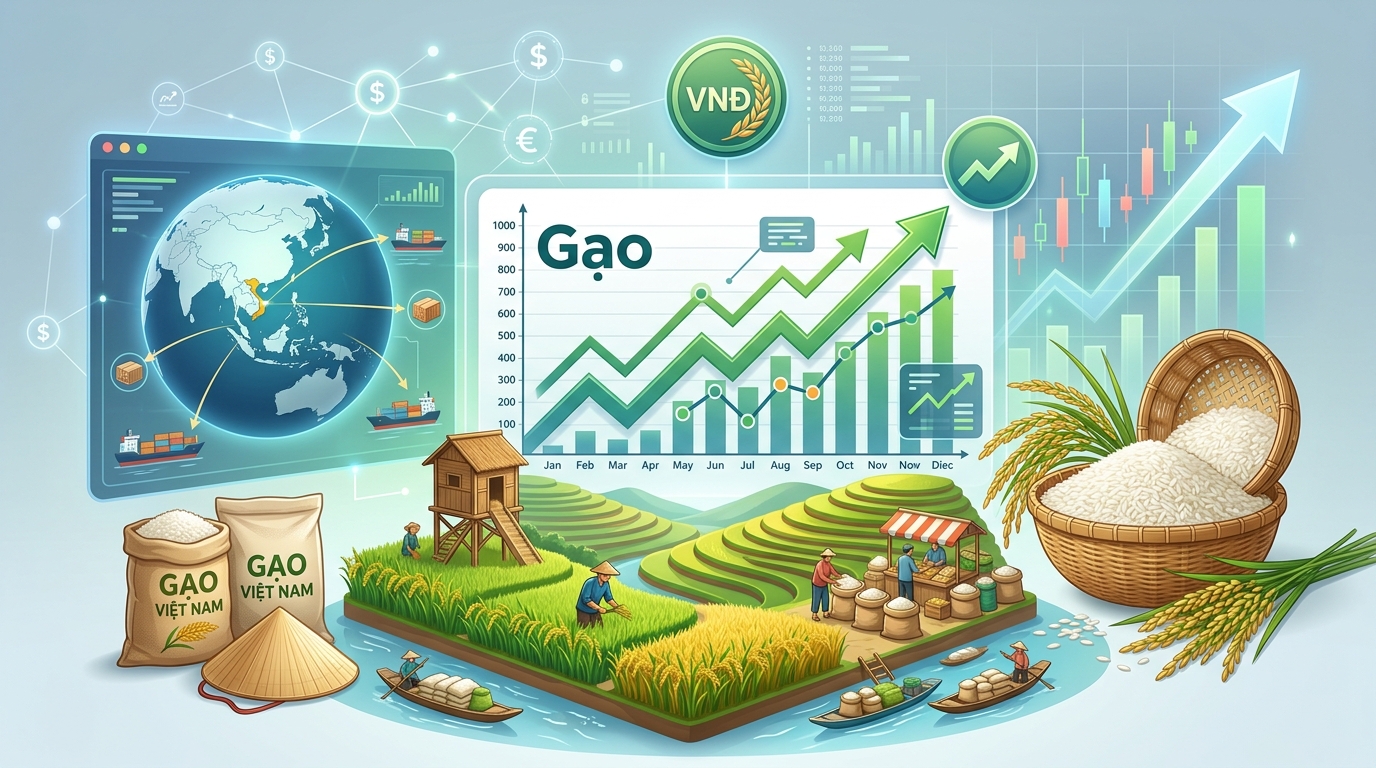
The global agricultural market, particularly rice, is experiencing significant volatility in the very first weeks of September 2026. After a period of maintaining high levels, rice prices recorded a significant drop on the trading session of September 7, 2026, sparking mixed opinions among analysts and import-export businesses. This article will delve into the rice price movements during the week of September 1 to September 30, 2026, dissecting the fundamental causes and evaluating the macroeconomic impacts reshaping the global rice trade map.
1. Rice Price Movements in Early September 2026: From Stability to Sharp Decline
Based on actual market data, global rice prices (listed in CWT - Hundredweight) experienced a volatile journey in just the first 7 days of September. Starting the month on September 1, 2026, rice prices stood at 15.33 USD/CWT (equivalent to approximately 7,994,810 VND/ton). In the following days, prices fluctuated slightly within a narrow range from 15.19 to 15.38 USD/CWT.
Notably, on September 5 and 6, rice prices reached a short-term peak of 15.38 USD/CWT (approximately 8,020,885 VND/ton). However, entering September 7, 2026, the market witnessed a sharp price shock. Rice prices fell to 13.84 USD/CWT (approximately 7,218,275 VND/ton), a drop of 1.54 USD in just 24 hours. This represents a decrease equivalent to more than 800,000 VND per ton of exported rice.
Despite this sudden decline, looking at the overall picture, the current average price for September remains at 15.08 USD/CWT, higher than the previous month's average (14.36 USD/CWT). This indicates that the market is in an extremely sensitive state, where supply-demand factors and investor sentiment are fiercely tugging at each other.
2. Causes of Rice Price Volatility in the Current Period
The fact that rice prices dropped by more than 10% in just one day (September 7) is not a coincidence. There are three main groups of causes leading to this adjustment:
Pressure from the Autumn-Winter Harvest in Vietnam and Southeast Asian Countries
September is the time when key rice-growing regions in the Mekong Delta (Vietnam) enter the peak of the Autumn-Winter harvest. Abundant supply flooding the market while business warehouses were already filled from the previous crop created short-term selling pressure. Not only Vietnam, but countries like Thailand and Cambodia are also seeing positive yields, easing concerns about global supply shortages that had been tight since the beginning of the year.
Policy Changes from Major Exporting Nations
India – the country accounting for more than 40% of the global rice market share – signaled in the first week of September 2026 that it would further relax export restrictions on non-basmati white rice. The expectation that a massive volume of Indian rice would return to the international market immediately put downward pressure on futures exchanges, causing speculators to quickly take profits and exit long positions.
Wait-and-See Sentiment of Major Importers
Leading rice-importing countries such as the Philippines, Indonesia, and China are tending to delay new purchase contracts to wait for lower prices. Seeing that supply is starting to increase and policy barriers are gradually being removed, buyers often choose a "wait-and-see" strategy, causing demand in the market to drop suddenly, pushing prices down deeply.
3. Analysis of Macroeconomic Influences on Rice Prices
Rice prices are not merely a story of grains and fields; they are the result of a complex network of intertwined macroeconomic factors.
Exchange Rate Volatility and the Strength of the USD
Rice is traded internationally primarily in USD. In early September 2026, the US Dollar Index (DXY) showed complex movements. When the USD strengthens, importing countries (which use their local currencies) have to pay more to purchase the same amount of rice, leading to a decline in demand. Conversely, in Vietnam, the USD/VND exchange rate remaining at a high level helps improve the export value converted into VND for businesses, but it also increases input costs such as fertilizers, pesticides, and fuel.
Logistics Costs and Global Supply Chains
Ocean freight rates in 2026 remain an unpredictable variable due to geopolitical instability in vital maritime routes. Although the free-on-board (FOB) price of rice may decrease, the cost to consumers (CIF) remains high because logistics costs do not decrease proportionally. This creates a disruption in price transmission, causing farmers not to fully benefit when global prices are high, but to suffer immediately when global prices fall.
Climate Change and Extreme Weather Events
Although September yields are positive, forecasts of the La Nina phenomenon at the end of 2026 are raising concerns about flooding in coastal areas of Southeast Asia. Weather uncertainty keeps rice prices maintaining a "risk premium." Investors remain cautious for fear that natural disasters could disrupt the supply chain at any time, keeping the average September price level (15.08 USD) higher than the previous month despite the drop on September 7.
4. Impact on the Vietnamese Rice Market
Vietnam, with its position as one of the three largest rice exporters in the world, is directly affected by these fluctuations. With the current price of approximately 7,218,275 VND/ton (based on the exchange rate on September 7), the profit margins of export businesses are being squeezed.
- For farmers: The price of fresh paddy in the field tends to decrease slightly following the downward trend of global prices. However, thanks to the high quality of this year's Autumn-Winter crop, the purchase price is still maintained at a profitable level for producers, even if it is no longer at the peak seen in the first months of the year.
- For export businesses: This is a "litmus test" period for forecasting capabilities. Businesses that signed futures contracts at prices above 15 USD/CWT have an advantage, while those holding large inventories purchased at high prices will face difficulties in competing on selling prices.
- Market strategy: Vietnam is gradually shifting from regular white rice to fragrant rice, high-quality rice, and low-emission rice. This strategy helps Vietnamese rice maintain its own customer segment, less affected by price-drop shocks of mass-market rice from India or Pakistan.
5. Forecast and Outlook for the Remainder of September 2026
Looking at the price range of the past 30 days (from 13.84 to 15.38 USD/CWT), it can be seen that the market is establishing a new floor. Below are some observations for the upcoming trend:
First, it is unlikely that rice prices will fall much further below the 13 USD/CWT level. This support threshold is reinforced by the fact that global production costs have increased significantly. Furthermore, the demand for food reserves for year-end holidays in Asian countries will begin to pick up from the end of September.
Second, volatility will continue to remain high. Until there are official and clearly quantified announcements regarding rice export volumes from India, the market will remain in a "defensive" state. Trading sessions may witness technical rebounds after the sharp drop on September 7.
Third, macroeconomic factors such as the US Federal Reserve (FED) interest rates and economic stimulus packages in China will indirectly affect the purchasing power of the agricultural market. If the USD cools down, rice prices denominated in USD may rise again.
Conclusion
The rice market in the first week of September 2026 sent a clear message about the sensitivity of global food security to policy and seasonal changes. The price drop on September 7 to 13.84 USD/CWT is a reminder to businesses that market risks are always present. However, with the average monthly price still growing compared to the previous month, the rice industry is still in a cycle of high economic value.
Vietnamese businesses need to closely monitor exchange rate developments and moves from India to have appropriate order-closing strategies. In a macroeconomic context with many uncertainties, focusing on quality and building sustainable supply chains will be the strongest "shield" to help Vietnamese rice overcome the rough waves of the global market.
Market Data Summary for the week of 01/09 - 07/09/2026:
- Highest price: 15.38 USD/CWT (September 5-6).
- Lowest price: 13.84 USD/CWT (September 7).
- Trend: Sharp short-term decline, but the monthly average remains high.
- Difference: Decreased by 1.54 USD (~802,610 VND/ton) compared to the weekly peak.