 Deutsch
  English
  Español
  Français
  Bahasa Indonesia
  日本語
日本語  한국어
한국어  Nederlands
  Português
  Tiếng Việt
  中文
中文 Rice Market in August 2026: Heat from Supply and Notable Macroeconomic Fluctuations
AI Report · Rice
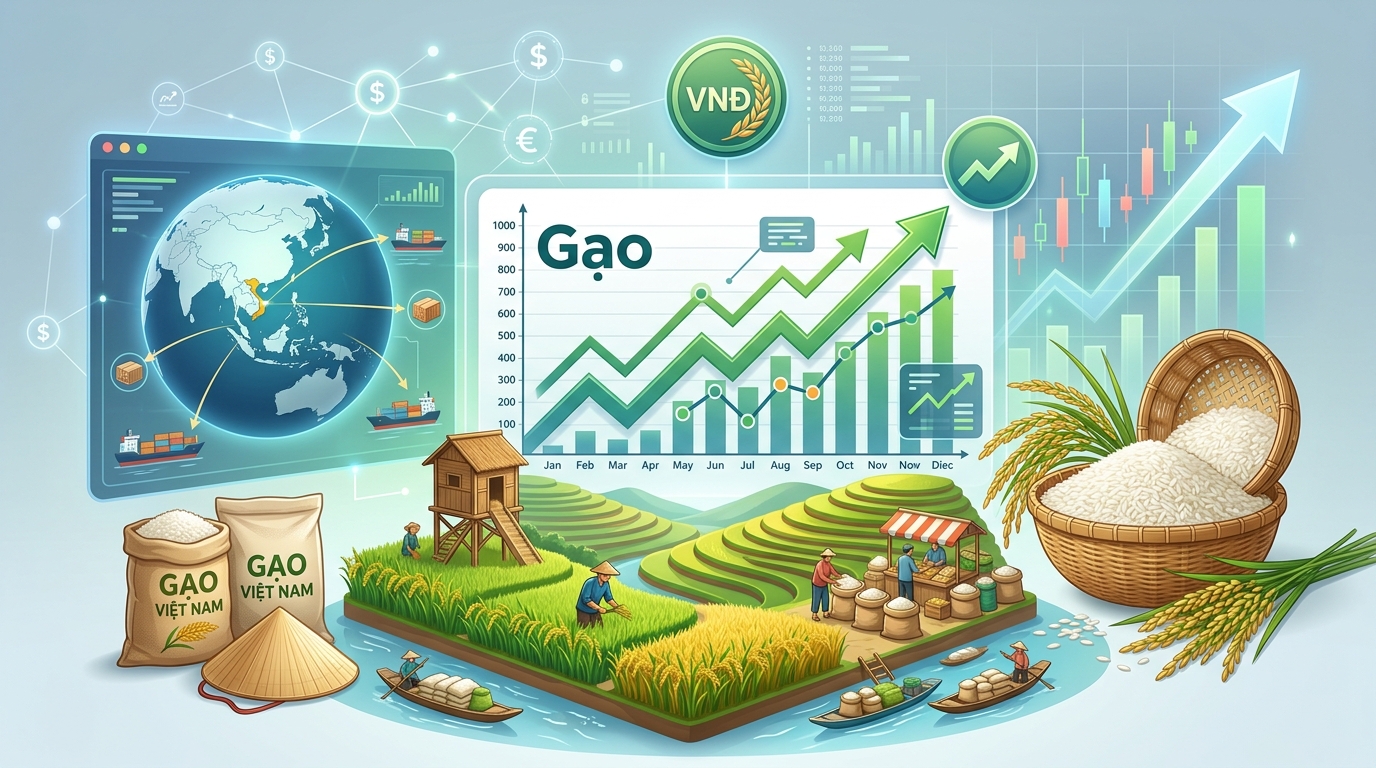
Entering August 2026, the global agricultural market in general and the rice market in particular are witnessing strong waves of volatility. Rice, a staple food for more than half of the global population, is becoming the focal point of attention for investors, governments, and consumers. Based on actual data from early August, rice prices are establishing a clear upward trend, reflecting supply uncertainties and profound changes in the global macroeconomic landscape.
Rice price movements in the first week of August 2026: A solid upward trend
According to the latest updated data as of August 7, 2026, global rice prices are listed at 14.28 USD/CWT (equivalent to approximately 7,492,573 VND/ton). Compared to the previous period, this is a significant increase, reflected in a change rate of +2.07%, corresponding to an increase of 0.29 USD (approximately 152,160 VND) per unit of measurement.
Looking back at the developments in the first 7 days of August, we can see a continuous escalation path:
- August 1 and August 2: Rice prices started the month at 13.96 USD/CWT.
- August 3: Prices jumped to 14.18 USD/CWT, showing a positive market reaction at the beginning of the trading week.
- August 4: There was a slight correction down to 13.97 USD/CWT, a common technical pullback.
- August 5 and August 6: Prices recovered strongly, reaching 14.06 USD and 14.19 USD/CWT, respectively.
- August 7: Reached a new weekly high at 14.28 USD/CWT.
The average price for August is currently at 14.08 USD/CWT, significantly higher than the previous month's average of 13.59 USD/CWT. The fluctuation range over the past 30 days has been between 13.35 and 14.31 USD/CWT, indicating that the market is trading at its highest price level in many months.
Analysis of the causes of rice price fluctuations
The increase in rice prices in the first week of August 2026 is not accidental but the result of a combination of many practical factors in the international and domestic markets:
1. Pressure from tight supply
August is often a sensitive time for the crop season in many major rice-exporting countries such as Vietnam, Thailand, and India. In Vietnam, the Summer-Autumn crop is entering the final harvest stage, while the Autumn-Winter crop has not yet yielded large volumes. Local scarcity of high-quality commercial paddy has pushed up purchasing prices at the field, thereby directly impacting export rice prices.
2. Strong increase in import demand from traditional markets
Major rice-importing countries such as Indonesia, the Philippines, and several African nations are stepping up purchases to build national reserves due to concerns about climate change. The continuous issuance of import tenders in early August has created demand-exceeding-supply pressure, giving exporters confidence to push up their asking prices.
3. Escalating production and logistics costs
Although global energy prices have seen some adjustments, shipping costs and fertilizer prices in 2026 remain high compared to the multi-year average. In particular, the shortage of empty containers at some ports in Southeast Asia has increased logistics costs, forcing exporters to add these costs to the product price.
Macroeconomic influences on rice prices in the current period
Rice prices are not only affected by pure supply and demand but are also strongly influenced by global macroeconomic factors. In August 2026, these factors are acting as important "catalysts":
Exchange rate fluctuations and the strength of the USD
International rice transactions are primarily conducted in USD. The fact that the USD maintains its strength or experiences unexpected fluctuations against the local currencies of exporting countries (such as the VND or Thai Baht) directly affects the profit margins of businesses. When the USD appreciates against the VND, the converted rice price in Vietnam tends to rise, putting pressure on domestic food inflation.
Food security policies and trade barriers
In a global geopolitical context that remains complex, the trend of food protectionism is returning. The fact that some countries are considering export restriction measures or additional tariffs to ensure domestic consumption has caused concern in the global market. Any announcement regarding export policies from India (which accounts for more than 40% of the global rice market share) is enough to cause global rice prices to fluctuate by 5-10% in just a few trading sessions.
Climate change and extreme weather phenomena
The year 2026 has recorded complex developments in weather cycles. Droughts in some key rice-growing areas and unusual storms and floods in Southeast Asian countries have raised concerns about crop yields. The futures market often reacts very quickly to bad weather forecasts, leading to higher rice prices due to speculative sentiment and risk hedging.
Global inflation and interest rates
Although many central banks have begun a path of interest rate cuts, the specter of inflation remains. As the prices of essential goods rise, it creates a cost-push spiral. Rice is a sensitive commodity that often increases in price following the general trend of agricultural products as capital flows seek refuge in real assets.
Impact on the Vietnamese rice market
Vietnam, as one of the world's top three rice exporters, is facing both opportunities and challenges in this price fluctuation cycle:
- Opportunities for farmers and businesses: Rising rice prices help improve the income of rice farmers, compensating for the high cost of agricultural materials. Businesses with existing low-cost inventory will see windfall profits.
- Challenges regarding domestic consumer prices: Rising export rice prices lead to higher domestic rice prices, putting pressure on the Consumer Price Index (CPI). This requires regulatory agencies to flexibly balance exports and domestic consumption to ensure national food security.
- Quality requirements: In the context of high prices, demanding import markets are becoming even stricter regarding quality and food safety standards. This is a motivation for the Vietnamese rice industry to shift more strongly toward fragrant and high-quality rice varieties.
Assessment and forecast for the end of August 2026
Based on the current growth momentum and macroeconomic analysis, it is forecast that rice prices in the remaining weeks of August 2026 will continue to remain high, with little possibility of a deep decline. The next resistance level could be at 14.50 USD/CWT.
However, the market should note factors that could cause a reversal, such as:
- The emergence of new supplies from main harvests in South Asian countries.
- Market intervention moves by the governments of major importing countries to curb prices.
- The stabilization of the global logistics supply chain.
Conclusion: The rice market in the first week of August 2026 reflects a "hot" state due to the combination of high demand and limited supply. For traders and exporters, this is a time to closely monitor information on international trade policies and weather developments. For consumers, adapting to a new price level in the short term is necessary as macroeconomic factors continue to support the upward trend of this important food commodity.
This article is synthesized and assessed based on actual market data as of August 7, 2026. Investors and businesses should consult additional official sources before making business decisions.