 Deutsch
  English
  Español
  Français
  Bahasa Indonesia
  日本語
日本語  한국어
한국어  Nederlands
  Português
  Tiếng Việt
  中文
中文 Lead Market in July 2026: Analysis of Stability Trends at the $1,900 Threshold and Macroeconomic Impacts
AI Report · Lead
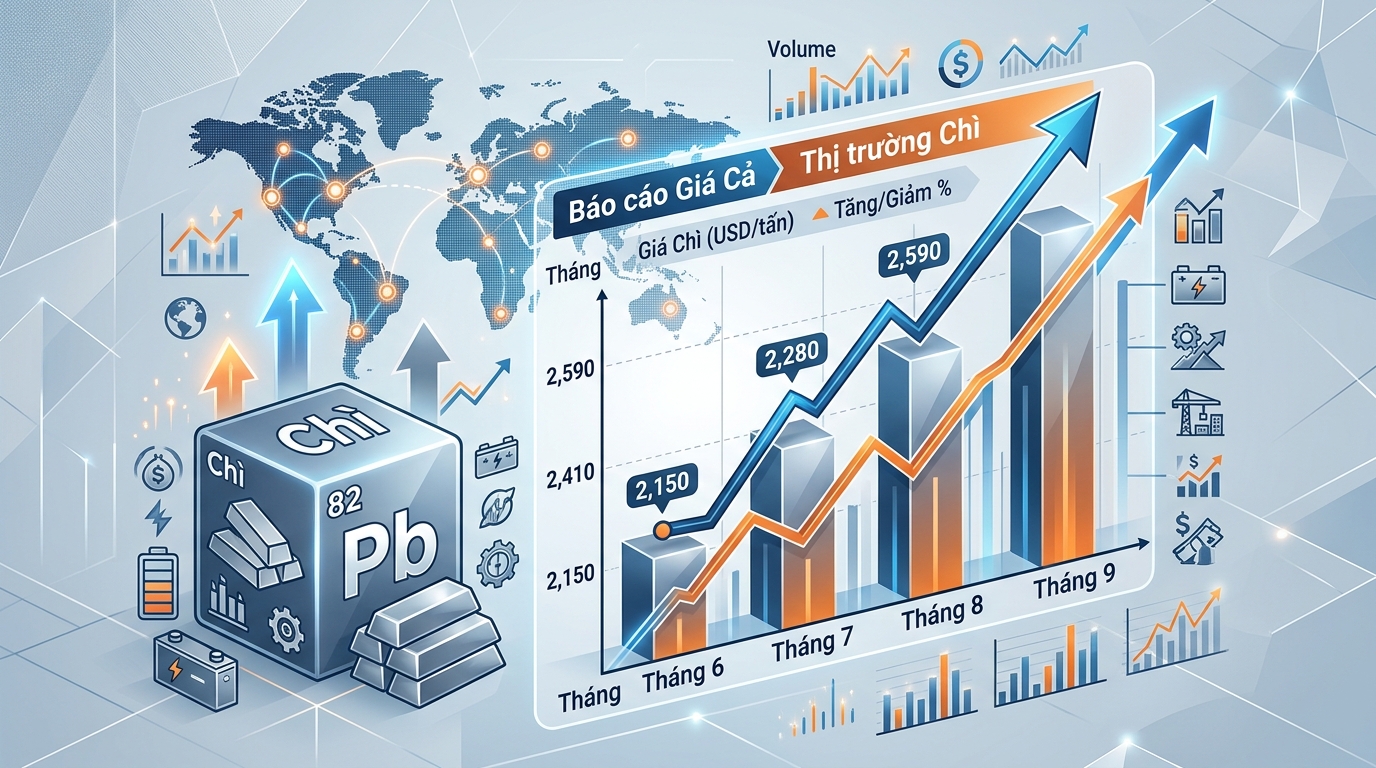
Entering July 2026, the global non-ferrous metals market in general, and the lead market in particular, are undergoing significant adjustments following a volatile second quarter. Based on actual data as of July 12, 2026, lead prices are showing a state of relative stability around the psychological support level of $1,900/mt. This article provides a detailed analysis of lead price movements during the week of July 1 to July 31, 2026, delving into the causes of volatility and examining the macroeconomic factors shaping the future of this metal.
1. Overview of the Global and Vietnamese Lead Market in the First Half of July 2026
According to the latest updated data on July 12, 2026, the global lead price is listed at $1,897.00/mt. In the Vietnamese market, this price is equivalent to approximately 49,831,724 VND/ton. Compared to the previous trading session, the price saw a slight increase of 0.18%, corresponding to a rise of $3.30 (approximately 86,687 VND).
Although stability has been recorded in recent days, looking at the broader picture, we see a significant decline compared to the previous month. The average price in June 2026 reached $1,964.73 (approximately 51,610,903 VND/ton), while the current average price for July is hovering at $1,890.64 (approximately 49,664,655 VND/ton). This indicates that the market has established a new price floor approximately 3.7% lower than the previous month.
In Vietnam, battery manufacturers and radiation shielding material producers are closely monitoring these developments. Maintaining lead prices below $1,900 provides some "breathing room" regarding input costs; however, the inconsistent volatility between global prices and logistics costs remains a major challenge for domestic importers.
2. Detailed Lead Price Fluctuations from July 1 to July 12, 2026
Looking at the price history over the last 10 days, we can observe a cautious sideways trajectory from investors:
- From July 3 to July 5, 2026: Prices remained stable at $1,894.40/mt. This was a period where the market awaited key economic reports from the US and China.
- July 6, 2026: Prices saw a slight decline to the cycle low of $1,884.50/mt. Selling pressure emerged as inventories at major exchanges showed signs of a slight increase.
- From July 7 to July 12, 2026: Prices began a slow but steady recovery, moving from $1,891.30 to $1,897.00. This recovery was primarily driven by bargain hunting as prices touched key technical support levels.
The price range over the past 30 days fluctuated between $1,874.90 and $1,983.20/mt. The gap of nearly $110 between the high and low points shows that despite current stability, the lead market still harbors potential for strong shocks if unexpected macroeconomic news arises.
3. Analysis of Causes for Lead Price Volatility
The decline from last month's average of $1,964 to the current $1,897 is not coincidental. There are three main groups of causes leading to this volatility:
3.1. Changes in the Demand Structure of the Electric Vehicle (EV) Industry
By 2026, the electric vehicle revolution has taken a step further. Although EVs primarily use Lithium-ion batteries, hybrid vehicles and low-cost EVs still utilize lead-acid batteries for auxiliary systems. However, technological improvements have helped reduce the amount of lead required per unit. This shift creates long-term downward pressure on lead prices as automakers seek lighter and more environmentally friendly alternatives.
3.2. Strong Increase in Recycled Lead Supply
During July 2026, developed nations have perfected their systems for collecting and recycling old batteries. The volume of secondary lead (recycled lead) flowing into the market has increased, reducing reliance on primary lead from mining. The production cost of recycled lead is typically lower and less affected by strict environmental regulations on mining, which has pulled the general price floor lower compared to the same period in previous years.
3.3. Inventory Status at LME and SHFE Exchanges
Reports from the London Metal Exchange (LME) show that lead inventory levels saw a slight increase in the first week of July. When reserves are abundant, concerns about supply shortages are eliminated, leading speculators to reduce long positions, putting pressure on prices and making it difficult to surpass the $1,950 threshold.
4. Macroeconomic Factors Affecting Lead Prices in July 2026
Lead prices are not only influenced by internal supply and demand laws but are also strongly governed by global macroeconomic variables:
4.1. Strength of the USD
As with all commodities priced in the greenback, lead prices always have an inverse relationship with the DXY index. In July 2026, the US Federal Reserve (Fed) signaled that it would maintain high interest rates to curb lingering inflation. This keeps the USD strong, making lead more expensive for buyers using other currencies (such as VND or EUR), thereby dampening demand and putting downward pressure on international listings.
4.2. China's Economic Situation
China remains the world's largest consumer and producer of lead. Any slowdown in the country's construction or industrial manufacturing sectors immediately impacts global lead prices. In the first half of July 2026, China's manufacturing data (PMI) showed uneven recovery, leading to cautious sentiment among traders at the Shanghai Futures Exchange (SHFE), indirectly causing global prices to move sideways.
4.3. Environmental and ESG Regulations
The year 2026 marks stricter standards for carbon emissions and hazardous waste management (ESG). Lead mines in Australia and Peru are facing higher operating costs to meet these standards. Although this increases production costs (which should theoretically push prices up), it also causes investors to withdraw capital from new mining projects, creating a fragile balance between supply and demand at lower price levels.
5. Impact on the Vietnamese Market and Advice for Businesses
In Vietnam, fluctuations in global lead prices have a certain lag when reflected in domestic retail prices. With prices around the 50 million VND/ton threshold, this is a critical time for domestic businesses to implement risk management strategies:
- For battery manufacturers: The current price level ($1,897) is in a good support zone. Businesses may consider locking in forward purchase contracts to protect themselves against potential price hikes in late Q3 when demand for winter stockpiling increases.
- For recycling units: It is necessary to optimize processes to reduce costs, as competition from cheap imported lead will increase when global prices remain low.
- Regarding financial management: As the USD/VND exchange rate continues to experience complex fluctuations in 2026, importers need to pay attention to exchange rate risk, because even if global lead prices are stable, if the VND depreciates, the actual cost in Vietnamese currency will still increase.
6. Lead Price Trend Forecast for the End of July 2026
Based on technical analysis and the macroeconomic context, lead prices in the remaining weeks of July 2026 are likely to continue fluctuating within a narrow range of $1,880 - $1,930/mt. It is very difficult to see a strong breakout above the $2,000 level without supply shocks from major mines or a sudden pivot in monetary policy from central banks.
The market is in a state of accumulation. Investors and businesses should closely monitor reports on LME inventory levels and economic indicators from China in the third week of the month to make timely adjustments to their business plans.
Conclusion
The lead market in the first week of July 2026 reflects a new equilibrium in the global economy following the pandemic and previous energy crises. At a price of $1,897.00/mt, lead is showing remarkable stability despite pressures from a strong USD and technological shifts. For the Vietnamese market, this is a "golden" period to observe and make strategic purchasing decisions in preparation for the year-end production cycle.
Understanding the causes of volatility and macroeconomic factors will help stakeholders avoid being passive in the face of the waves of this volatile non-ferrous metals market.