 Deutsch
  English
  Español
  Français
  Bahasa Indonesia
  日本語
日本語  한국어
한국어  Nederlands
  Português
  Tiếng Việt
  中文
中文 Lead Market in September 2026: Stability Amid Global Supply Chain Restructuring
AI Report · Lead
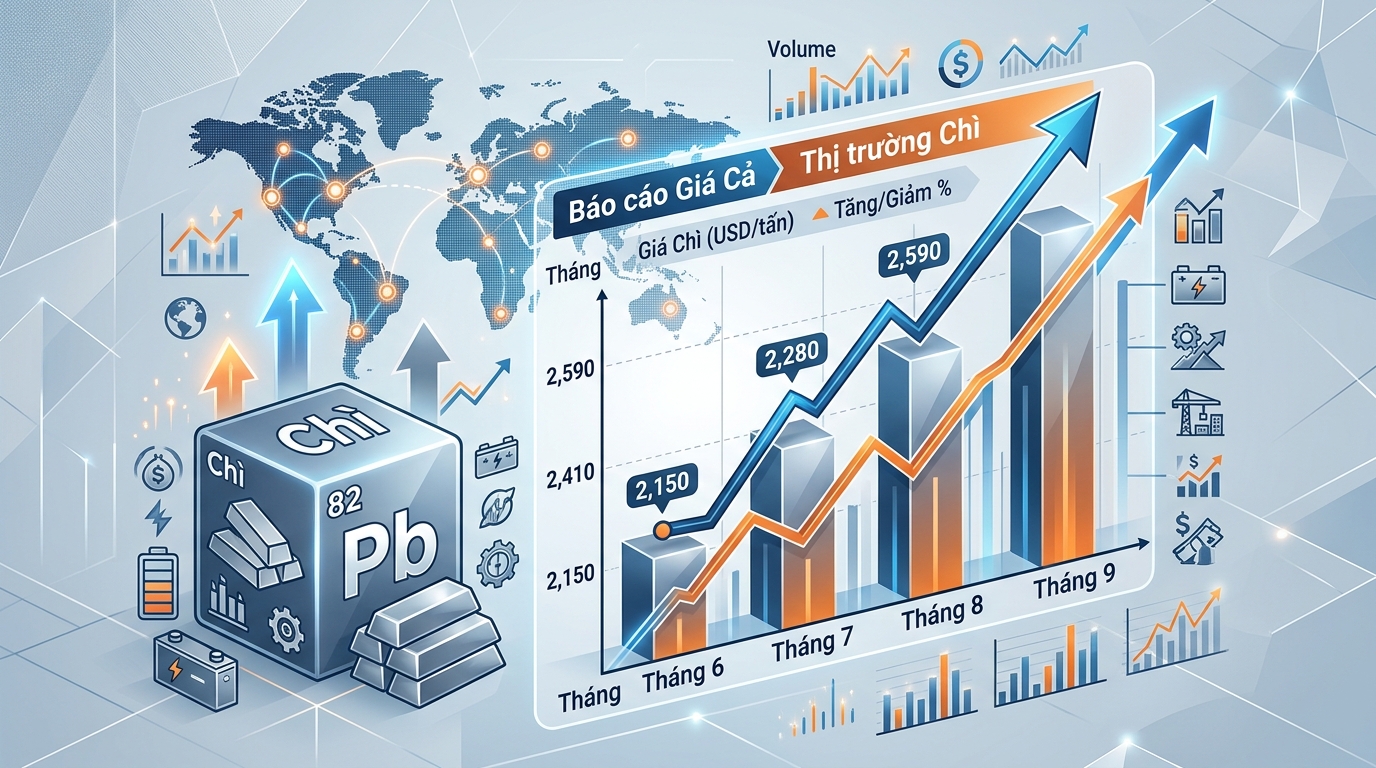
The global non-ferrous metals market is entering the final stage of the third quarter of 2026 with relatively stable developments, though they contain many signs of divergence. Among base metals, Lead (Lead) is attracting the attention of investors and manufacturing enterprises due to its price stability within a narrow range. This article provides a detailed analysis of the lead market situation in Vietnam and globally from September 1, 2026, to September 30, 2026, based on actual data and macroeconomic factors directly impacting this commodity.
1. Overview of Lead Price Trends in September 2026
As of mid-September 2026, specifically September 12, the global lead price is listed at 1,892.90 USD/mt (equivalent to approximately 49,068,700 VND/ton). In general, the dominant market trend during this period is stability, with a slight change of approximately +0.49% compared to previous trading sessions.
Below is a summary table of key price indicators in September 2026:
- Current Price (12/09/2026): 1,892.90 USD/mt ≈ 49,068,700 VND/ton.
- Current Month Average Price: 1,905.31 USD/mt ≈ 49,390,398 VND/ton.
- Previous Month Average Price (08/2026): 1,898.27 USD/mt ≈ 49,207,904 VND/ton.
- 30-Day Fluctuation Range: 1,889.70 - 1,919.90 USD/mt.
Observing daily data from the beginning of September, we see a slight correction. After reaching a high of 1,916.20 USD/mt on September 8, the lead price trended downward toward the 1,892.90 USD/mt threshold on September 11 and 12. The decline of about 24 USD/mt (equivalent to nearly 600,000 VND/ton) in less than a week indicates profit-taking pressure from speculators and caution from downstream procurement units.
2. Analysis of Factors Causing Lead Price Fluctuations
The stability accompanied by slight price corrections for lead in September 2026 is not coincidental. There are three main groups of causes leading to this situation:
2.1. Balance Between Traditional Supply and Demand
Lead remains an essential component in the production of lead-acid batteries, which still account for a large share of the automotive industry and backup power storage systems. In September, demand from the automotive manufacturing industry in major markets like China and Europe showed signs of stagnation. The shift toward electric vehicles (EVs) using Lithium-ion batteries is occurring strongly, but the demand for replacement batteries for traditional gasoline vehicles still maintains a safe "buffer zone" for lead prices.
2.2. Inventory Situation at Exchanges
Lead inventory levels at the London Metal Exchange (LME) and the Shanghai Futures Exchange (SHFE) in September 2026 remained at average levels. When inventory levels do not experience sudden drops or excessive surpluses, prices tend to fluctuate within a narrow range. The slight decline from 1,916 USD to 1,892 USD in the middle of the month may be due to a new supply of reserves released into the market by refineries in Southeast Asia.
2.3. Energy Costs and Secondary Lead Production
Secondary lead production (recycled lead) contributes more than 50% of total global lead output. During September 2026, relatively stable global energy prices helped recycling plants maintain steady capacity. This prevented supply shocks, keeping lead prices from being pushed too high even when consumption demand increased locally at times.
3. Macroeconomic Influences on Lead Prices in the Current Period
To better understand the 1,892.90 USD/mt price level, we need to place it in the context of the 2026 global macroeconomic environment.
3.1. Monetary Policy and the Strength of the USD
Metals such as lead are always sensitive to fluctuations in the USD. In September 2026, reports from the US Federal Reserve (Fed) indicated a neutral stance on interest rates following a prolonged tightening cycle. The stability of the USD prevents the prices of commodities denominated in this currency from fluctuating too strongly due to exchange rate factors. In Vietnam, the stable USD/VND exchange rate also helps ensure that the lead price converted into VND (approximately 49 million VND/ton) does not cause cost shocks for importing enterprises.
3.2. Green Energy Transition Trend
Although lead is often considered an "old metal" compared to Lithium or Cobalt, in 2026, the role of lead in energy storage systems (ESS) in developing countries is increasing. Household-scale solar power systems in Southeast Asia and Africa still prioritize the use of lead-acid batteries due to their low cost and high recyclability. The increase in demand in this segment has offset the decline in demand from the traditional automotive industry in developed countries.
3.3. Environmental and Mining Regulations
2026 has seen stricter environmental regulations for lead and zinc mines (which are often mined together). Tightening waste treatment processes at mines in Australia and Peru has increased marginal mining costs. This is a strong supporting factor, preventing lead prices from falling deep below the 1,850 USD/mt threshold.
4. Lead Market in Vietnam: Opportunities and Challenges
In Vietnam, domestic lead prices closely follow LME price movements. With a price of 49,068,700 VND/ton on September 12, domestic battery manufacturers such as Pinaco or Tia Sang are facing a raw material market that is relatively more comfortable compared to the sharp fluctuations of previous years.
Regarding supply: Vietnam still depends partly on imported lead ingots and domestic recycled lead sources. However, the Government's policies to promote a circular economy are creating conditions for lead recycling plants to increase capacity, helping to reduce dependence on global price fluctuations.
Regarding demand: The electric motorcycle and electric bicycle market in Vietnam is booming. Although many high-end models use Lithium batteries, the low-cost electric vehicle segment still uses dry lead-acid batteries. This creates a stable demand flow for the domestic lead market throughout September 2026.
5. Outlook and Forecast for Late September 2026
Based on historical data from the past 30 days (range of 1,889.70 - 1,919.90 USD/mt), we can make some assessments for the second half of September 2026:
- Base Case Scenario: Lead prices will continue to move sideways in the 1,890 - 1,910 USD/mt range. This stability will persist if there are no major geopolitical events or sudden changes in the monetary policy of major central banks.
- Downside Risk: If LME inventories increase sharply due to weaker-than-expected consumption demand in China, prices could retest the 1,880 USD/mt support level (equivalent to approximately 48.7 million VND/ton).
- Upside Potential: Supply disruptions at some major mines or a sudden surge in demand for renewable energy storage projects at the end of the third quarter could push prices back to the 1,920 USD/mt level.
Advice for businesses: In the context of lead prices being at an average and stable level (1,892.90 USD/mt), this may be an appropriate time for manufacturing enterprises to lock in purchase contracts for the fourth quarter of 2026. Maintaining a raw material reserve at this price level helps minimize risks when the market enters the peak consumption period at the end of the year.
Conclusion
The lead market in September 2026 is showing a calm face amidst global economic fluctuations. The price level around 49 million VND/ton reflects a fragile but necessary balance between recycled supply and shifting industrial demand. For investors and businesses in Vietnam, closely monitoring macroeconomic indicators and global inventory levels will be the key to making accurate business decisions during this period.
Note: The information and figures in this article are based on market data as of September 12, 2026, and are for reference purposes for market analysis only.