 Deutsch
  English
  Español
  Français
  Bahasa Indonesia
  日本語
日本語  한국어
한국어  Nederlands
  Português
  Tiếng Việt
  中文
中文 Lead Market June 2026: Strong Volatility and Recovery Pressure from Short-Term Lows
AI Report · Lead
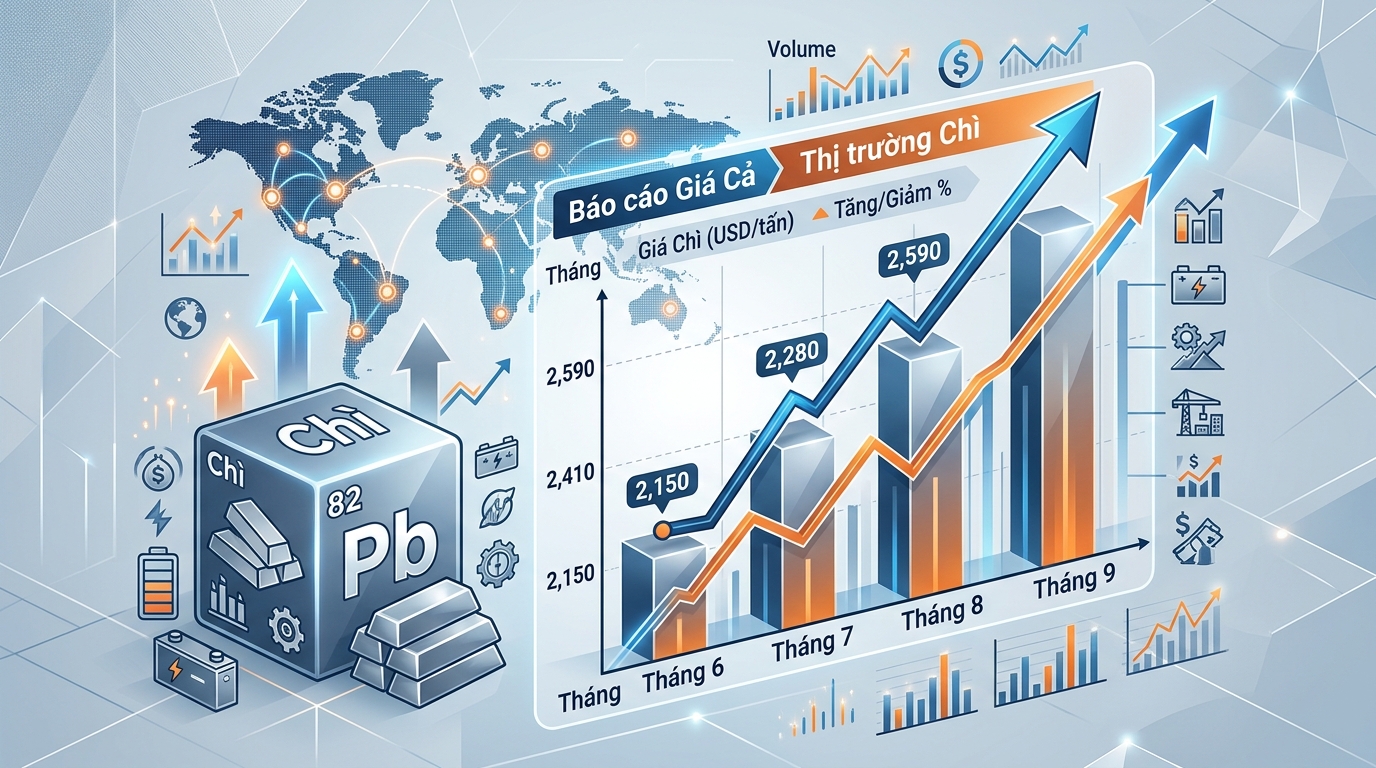
The global non-ferrous metal market is experiencing the first weeks of June 2026 with many complex developments, in which Lead (Lead) is becoming the focal point for investors and battery manufacturers. After a period of deep correction at the beginning of the month, Lead prices have shown signs of recovery in the most recent trading sessions. This article will delve into the analysis of Lead price movements in Vietnam and globally from 01/06/2026 to 30/06/2026, while dissecting the macro and micro factors affecting this market.
1. Overview of Lead price movements in the first half of June 2026
As of 12/06/2026, the global Lead price listed on the LME (London Metal Exchange) stands at 1,967.10 USD/mt, equivalent to approximately 51,782,924 VND/ton. Although this figure is still lower than the peak at the beginning of the month, the trading session on 12/06 recorded an increase of +1.04% (equivalent to an increase of 20.20 USD/mt), showing a significant recovery effort from the buy side.
Looking back at the price chart for the first 12 days of June, we see a fairly clear "V" shaped volatility trend:
- Decline phase (01/06 - 11/06): Lead prices started June at a fairly high level, reaching 2,024.30 USD/mt on 03/06. However, selling pressure pushed prices continuously downward, touching a 30-day low of 1,946.90 USD/mt on 11/06.
- Recovery phase (12/06): After hitting the psychological support threshold below 1,950 USD, bottom-fishing cash flow appeared, bringing the price back to the 1,967.10 USD mark.
In the Vietnamese market, domestic Lead prices fluctuate closely with global prices but have a certain lag due to logistics costs and exchange rates. The price range over the past 30 days has fluctuated between 51,251,169 VND/ton and 53,899,414 VND/ton. The current average monthly price is maintaining at 1,998.05 USD (approximately 52,597,667 VND/ton), slightly higher than the May average (1,993.40 USD), indicating that the general price level is still trending slightly upward despite strong shocks.
2. Analysis of the causes of Lead price volatility
The sharp decline in the first 10 days of June and the sudden recovery on 12/06 were not coincidental. There are three main groups of causes leading to this situation:
Fluctuations in LME inventories
In the first week of June, Lead inventory levels at LME-monitored warehouses recorded a sudden increase in Asian regions, especially in Singapore and South Korea. The high short-term availability of supply created pressure that caused traders to increase selling, pushing prices from the 2,020 USD zone to below 1,950 USD in just one week. However, by 11/06, data showed that the volume of cancelled warrants began to rise, implying that actual consumption demand is returning, helping prices jump 1.04% on 12/06.
Operational status of smelters
June is usually the time when lead smelters in China and Europe enter their periodic maintenance cycle. Information about several large smelters in Henan province (China) cutting production due to new environmental regulations has raised concerns about primary Lead supply. This acts as an important support, preventing a deep decline in Lead prices as they approach the 1,940 USD zone.
Demand from the battery industry
Although electric vehicles (EVs) are developing strongly, the demand for traditional lead-acid batteries remains very high, especially in the commercial vehicle sector, renewable energy storage systems, and starter batteries for hybrid vehicles. In Vietnam, battery manufacturers are beginning to stockpile raw materials for the year-end peak consumption season, creating stable domestic demand, contributing to keeping Lead prices from falling too deeply compared to the general metal market level.
3. Macro influences on Lead prices in June 2026
Lead prices are not only affected by direct supply and demand but are also strongly influenced by global macroeconomic factors. In the context of June 2026, the following factors are playing a decisive role:
Monetary policy and the strength of the USD
The USD (DXY Index) always has an inverse relationship with the prices of basic commodities. In early June, signals that the US Federal Reserve (Fed) might maintain interest rates at high levels longer than expected to curb inflation caused the USD to strengthen. When the USD rises, Lead (which is priced in USD) becomes more expensive for buyers using other currencies, leading to a drop in demand. However, weaker-than-expected economic data released on 11/06 softened the USD's strength, paving the way for the recovery of Lead prices on 12/06.
Economic growth in China
As the world's largest Lead consumer, China's economic health has a direct impact on the market. China's June manufacturing reports (PMI) showed a slight recovery in the machinery manufacturing and electronic components export sectors. This brings expectations that industrial metal consumption demand, including Lead, will improve in the third quarter of 2026.
Geopolitical tensions and energy costs
Energy prices (electricity and gas) remain high due to geopolitical instability in oil-supplying regions. For the metallurgical industry, energy costs account for 30-40% of production costs. High input costs force lead smelters to maintain selling prices at a certain level to ensure profit margins, establishing a "floor" for Lead prices in the global market.
4. Lead market in Vietnam: Opportunities and Challenges
In Vietnam, the Lead price is currently maintaining around 51,782,924 VND/ton. This is a relatively comfortable price level for domestic manufacturers compared to the skyrocketing price increases of previous years. However, the domestic market still faces several challenges:
- Exchange rate risk: Fluctuations in the USD/VND exchange rate are directly affecting the import price of lead ingots and lead scrap. Businesses need to have exchange rate risk hedging strategies to stabilize input costs.
- Recycling trend: The Vietnamese government is tightening environmental regulations for craft villages and manual lead recycling facilities. This promotes the shift to modern, large-scale recycling plants, but also increases compliance costs in the short term.
- Demand from energy infrastructure: The implementation of solar and wind energy projects accompanied by battery energy storage systems (BESS) is opening up great opportunities for the lead battery industry in Vietnam, thereby supporting domestic Lead prices.
5. Assessment and forecast for the second half of June 2026
Based on actual data and macroeconomic analysis, we provide the following assessment of the Lead market in the coming weeks:
Short-term: Lead prices are unlikely to break through the 2,050 USD/mt threshold strongly because inventory levels are still quite high. However, the 1,940 - 1,950 USD support level proves to be very solid. It is forecast that Lead prices will continue to fluctuate in a narrow range from 1,960 - 2,010 USD/mt for the remainder of June.
Medium-term: The market is waiting for more important economic reports from the US and China. If China's stimulus policies have a more pronounced effect by the end of the second quarter, Lead prices could establish a new higher price base, heading towards the 2,100 USD mark in July or August.
Advice for businesses: With the current price (approximately 51.7 million VND/ton), this may be an appropriate time for battery manufacturers and producers of Lead-based products to carry out purchasing operations to stockpile a portion of raw material needs for the third quarter. The fact that the price just jumped 1.04% after hitting a 30-day low shows that downward pressure has eased and the market is finding a new equilibrium point.
In summary, the week from 01/06 to 12/06/2026 witnessed a strong purification in the Lead market. Although there were times when prices fell deeply, the general outlook remains positive thanks to the recovery of industrial demand and supporting factors from production costs. Investors and businesses need to closely monitor LME inventory fluctuations and exchange rates to make the most accurate business decisions.
Information summarized and analyzed based on market data as of 12/06/2026.