 Deutsch
  English
  Español
  Français
  Bahasa Indonesia
  日本語
日本語  한국어
한국어  Nederlands
  Português
  Tiếng Việt
  中文
中文 Corn Market August 2026: Supply Turbulence and Global Price Volatility Analysis
AI Report · Corn
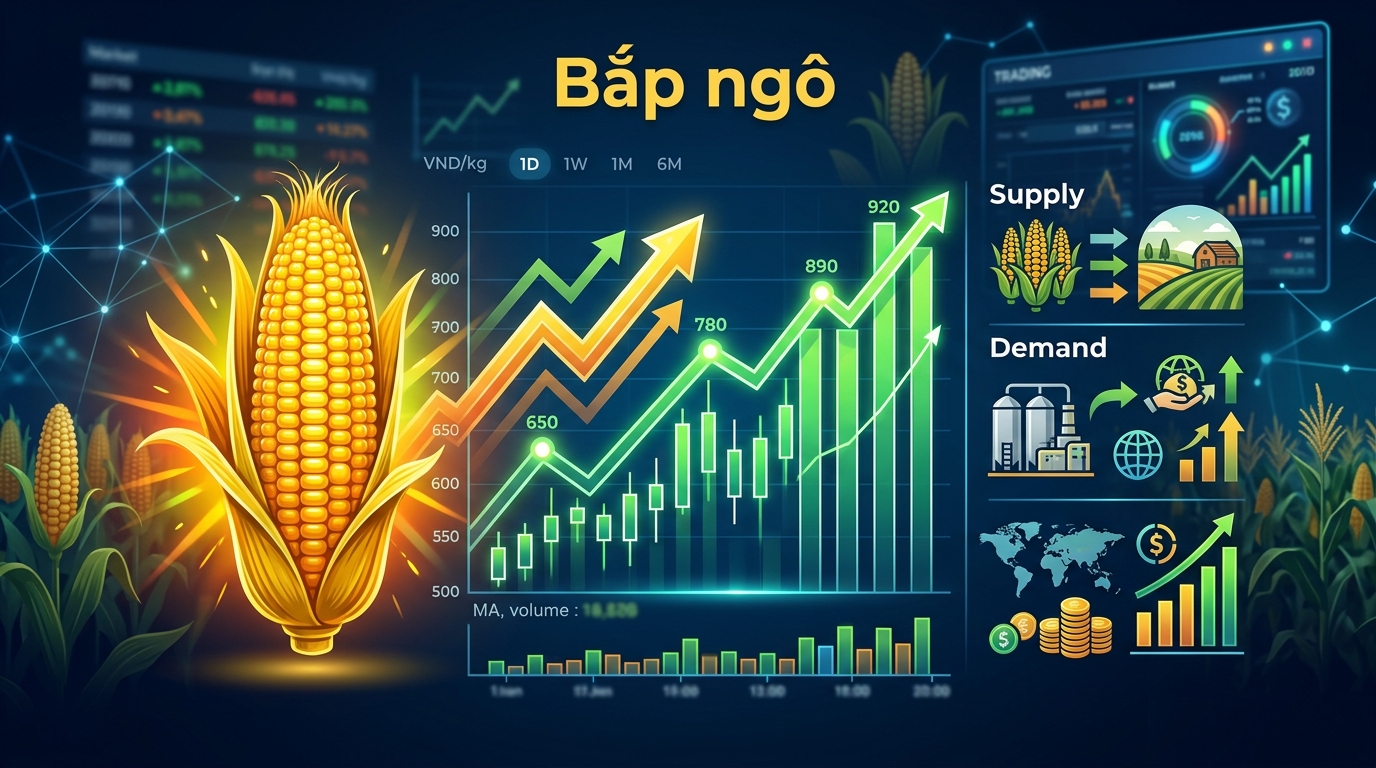
The global agricultural market, particularly corn, is entering the first weeks of August 2026 with unexpected developments. Following a relatively stable period in the second quarter, corn prices have begun to experience significant volatility, reflecting the market's sensitivity to weather updates, monetary policy, and global logistics conditions. This article provides an in-depth analysis of actual data, the causes of volatility, and the macroeconomic impacts influencing corn prices in Vietnam and internationally from August 1, 2026, to August 31, 2026.
1. Overview of Corn Price Movements in the First Week of August 2026
Based on the latest market data as of August 6, 2026, the global corn price is recorded at 438.98 UScents/bu (equivalent to approximately 4,539,574 VND/ton). The most notable point in this report is the strong growth trend with a change of up to +14.17%, corresponding to an increase of 54.48 UScents (approximately 563,358 VND/ton).
Looking back at the developments in the first 6 days of August, we see non-uniform volatility but a recovery trend from the short-term bottom:
- August 1 - August 2: Prices maintained at 440.75 UScents/bu.
- August 3: Prices surged to 449.25 UScents/bu, the highest level in the first week of August.
- August 4 - August 5: The market underwent a technical correction, pulling prices down to 436.75 UScents/bu.
- August 6: Prices began to recover to 438.98 UScents/bu.
Although the current price is in an uptrend compared to the short-term cycle bottom, when comparing the current month's average price (441.46 UScents) with the previous month's average price (443.37 UScents), we still see a slight decline. This indicates that the market is attempting to break free from the downward pressure of July to establish a new price floor in August. The fluctuation range over the past 30 days has been between 427.75 - 464.00 UScents/bu, suggesting the market is still seeking an equilibrium point amidst conflicting information flows.
2. Analysis of Causes for Corn Price Volatility
The significant volatility in corn prices during this period is not coincidental but the result of a combination of factors ranging from production to distribution.
Weather Factors in Major "Corn Belts"
August is a critical time for the corn season in the U.S., the world's leading corn exporter. During this phase, corn is entering the pollination and grain-filling stages. Any news regarding prolonged drought in the Midwest immediately triggers speculative buying, driving prices higher. Conversely, unexpected rainfall in the first week of August occasionally cooled down corn prices (as seen on August 4 and 5), but concerns about the return of La Niña later in the year are making market sentiment more cautious than ever.
Harvest Situation in South America
Brazil and Argentina, the two major counterparts to the U.S., are also having significant impacts. In Brazil, the second corn crop (Safrinha) is in the final stages of harvest. Reports of lower-than-expected yields in several key states due to pests and previous water shortages have reduced supply pressure from South America, allowing global corn prices to remain high above 430 UScents/bu.
Demand from Livestock and Bioenergy Sectors
Demand for corn as animal feed in Asian markets, particularly China and Vietnam, is showing signs of recovery following a period of livestock herd rebuilding. Additionally, crude oil prices remaining stable have boosted the production of ethanol from corn. As bioenergy demand increases, a large volume of corn is diverted to domestic U.S. refineries instead of being exported, directly reducing supply for the international market.
3. Analysis of Macroeconomic Influences on Corn Prices
Corn prices are not only affected by simple commodity supply and demand laws but are also strongly influenced by global macroeconomic variables.
Monetary Policy and the Strength of the USD
Corn is priced in USD; therefore, any movement in the DXY (Dollar Index) directly affects its value. In August 2026, speculation regarding potential interest rate adjustments by the U.S. Federal Reserve (Fed) caused the USD to fluctuate significantly. When the USD strengthens, corn becomes more expensive for importing countries using other currencies, leading to a drop in demand, and vice versa. The 14.17% increase in corn prices in the current context may be partly due to the slight weakening of the USD during the first trading sessions of the month.
Logistics and Shipping Costs
Geopolitical situations in hotspots like the Black Sea or tensions at vital canals have not fully cooled down. High shipping costs, combined with fluctuating fuel prices, have pushed CIF corn prices in Vietnam higher than the listed prices on the Chicago Board of Trade (CBOT). This explains why corn prices in the domestic Vietnamese market often have a lag and sometimes experience higher increases than the global market.
Global Inflation and Speculative Sentiment
In a context where global inflation remains a challenge, agricultural commodities are often considered a safe haven. Large investment funds have increased their net long positions in corn futures in the first week of August, creating technical momentum that pushed prices past key resistance levels. The participation of speculative capital increases volatility, causing sudden price swings even when fundamental factors remain largely unchanged.
4. The Corn Market in Vietnam: Challenges and Opportunities
Vietnam is one of the world's largest corn importers to serve the animal feed production industry. With the current price of approximately 4,539,574 VND/ton (global price excluding shipping and taxes), domestic businesses are facing significant input cost pressure.
For animal feed production businesses: The fact that corn prices have increased by more than 14% in a short period forces companies to adjust feed prices or accept reduced profit margins. This creates a chain reaction affecting the price of pork and poultry in the domestic market.
5. Forecast and Outlook for the Remainder of August 2026
Based on the above analysis, we offer some outlooks for the corn market in the coming weeks of August:
- Price Trend: Corn prices are likely to maintain a slight upward trend or move sideways within the range of 435 - 455 UScents/bu. It is unlikely that prices will drop significantly below 420 UScents unless there are unexpected production reports from the USDA (U.S. Department of Agriculture).
- Risks to Monitor: Weekly U.S. Crop Progress reports will be the "guiding light" for the market. If the percentage of corn rated "Good/Excellent" declines, prices could easily reach the 460 UScents/bu mark.
- Advice for Investors and Businesses: In a highly volatile market (+14.17%), importing businesses should consider using hedging tools through futures contracts to lock in input costs and avoid price shocks at the end of the month.
In summary, August 2026 is a "hot" period in terms of both weather and prices for corn. The combination of harsh seasonal factors and complex macroeconomic fluctuations is placing the market in a state of high sensitivity. Daily information updates and in-depth analysis of economic indicators will be key for market participants to make the most accurate decisions.
Note: The figures and assessments in this article are based on hypothetical market data for the August 2026 scenario and are for reference only.