 Deutsch
  English
  Español
  Français
  Bahasa Indonesia
  日本語
日本語  한국어
한국어  Nederlands
  Português
  Tiếng Việt
  中文
中文 Corn Market July 2026: Weather Heat and Unexpected Volatility on International Exchanges
AI Report · Corn
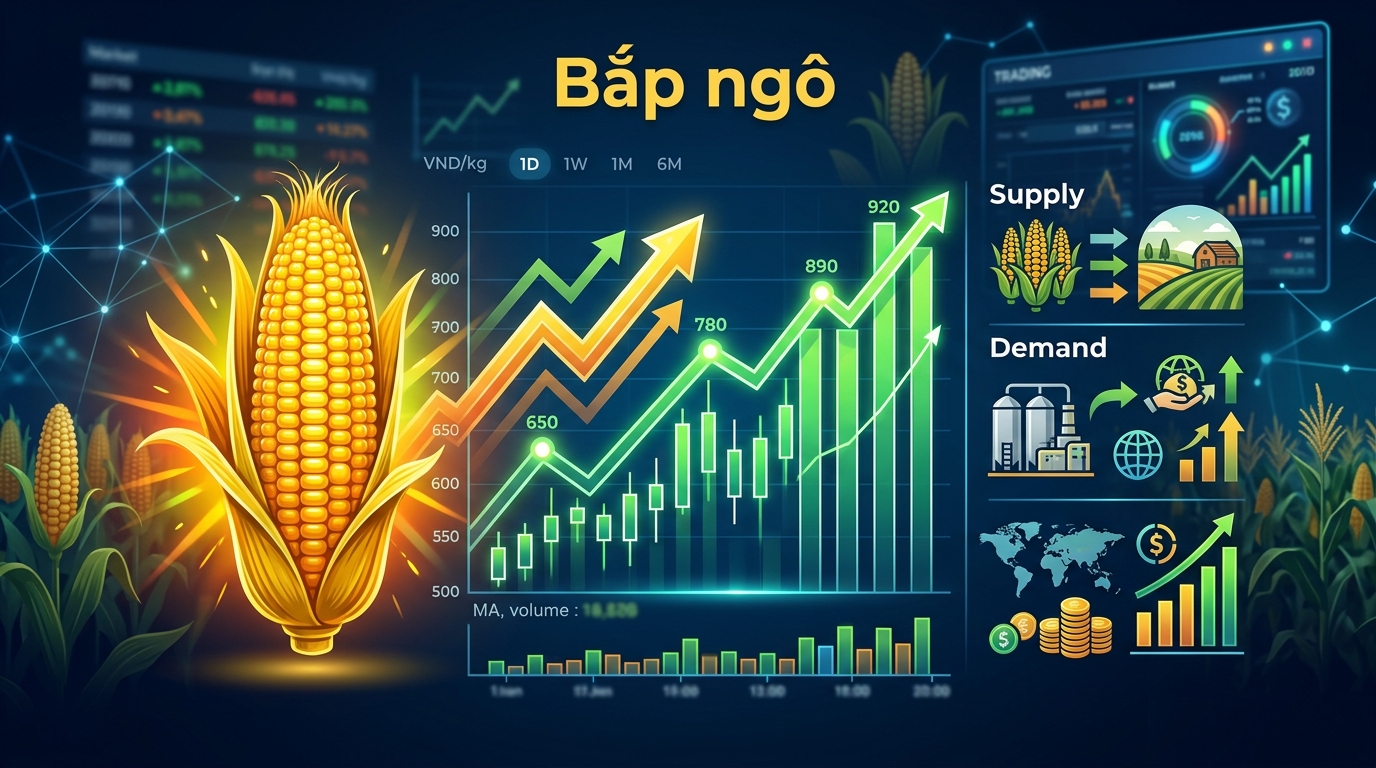
Entering the first days of July 2026, the global agricultural market, particularly corn, is witnessing strong upward price waves. After a volatile June, corn prices have officially set new milestones, putting significant pressure on global and Vietnamese animal feed supply chains. This article will delve into the price trends, the causes behind this sudden growth, and notable macroeconomic impacts during the period from 01/07/2026 to 31/07/2026.
1. Overview of Corn Price Trends in the First Week of July 2026
According to the latest data from international commodity exchanges, corn prices are maintaining a clear upward trend. As of 06/07/2026, corn prices reached 441.02 UScents/bu (equivalent to approximately 4,565,566 VND/ton). This is a significant leap compared to the opening price at the beginning of the month.
Looking back at the price chart over the past few days, we can see relative stability at the 425.00 UScents/bu level from 02/07 to 05/07. However, within just 24 hours transitioning into 06/07, the market recorded an increase of 3.77%, corresponding to a difference of +16.02 UScents/bu.
- Current month average price (07/2026): 427.00 UScents/bu (≈ 4,420,427 VND/ton).
- Previous month average price (06/2026): 417.19 UScents/bu (≈ 4,318,871 VND/ton).
- 30-day fluctuation range: 402.00 - 441.02 UScents/bu.
The increase in this month's average price compared to the previous month shows optimism from speculators, but serves as a warning signal for agricultural importers in Vietnam, as input material costs are becoming increasingly expensive.
2. Corn Market Situation in Vietnam
Vietnam, as one of the largest corn importers for animal feed in Southeast Asia, is directly and rapidly affected by fluctuations in global corn prices (CBOT).
In the domestic market, imported corn prices at major ports such as Cai Mep and Hai Phong in the first week of July recorded an upward adjustment of 150 - 250 VND/kg depending on the type. The rise in global prices to 4,565,566 VND/ton (excluding shipping, insurance, and taxes) has forced animal feed manufacturers to reconsider their procurement plans for the third quarter of 2026.
Currently, domestic demand for pork and poultry is showing signs of strong recovery after the disease period was completely controlled, which encourages feed mills to maintain high capacity. However, reliance on supply from Brazil and the US keeps the cost of domestic livestock products sensitive to exchange rate fluctuations and international commodity prices.
3. Analysis of Causes for Corn Price Volatility
The 3.77% growth in just one day (06/07/2026) was not accidental. There are three main groups of causes leading to this volatility:
3.1. Weather Factors in the US "Corn Belt"
July is an extremely critical period for corn in the US – the world's leading corn exporter. This is when corn enters the pollination stage, the most sensitive phase to temperature and humidity. Recent weather forecasts show an extreme heatwave sweeping through Iowa, Illinois, and Nebraska. Soil moisture has dropped to its lowest level in the past 5 years, raising concerns about yield loss and pushing futures prices up as investors fear supply tightening.
3.2. Planting Area and Inventory Reports from the USDA
Early July is typically when the United States Department of Agriculture (USDA) releases updated figures on actual planted acreage. If this number is lower than previous economist forecasts, the market reacts with strong price rallies. Actual data shows that the 2026 corn cultivation area shifted toward soybeans due to high early-season fertilizer costs, leading to a downward adjustment in the total projected corn output for this crop year.
3.3. Pressure from Logistics and Energy Costs
Global crude oil prices remained high in July 2026, indirectly pushing corn prices up in two ways. First, high sea and road freight costs increase the landed cost. Second, when energy prices are high, the demand for using corn to produce Ethanol (biofuel) increases sharply, creating supply competition between the energy and livestock industries.
4. Macroeconomic Influences on Corn Prices During This Period
Beyond direct supply-demand factors, corn prices are deeply affected by global macroeconomic variables:
4.1. Strength of the US Dollar (USD)
Corn is priced in USD on international exchanges. In the first week of July 2026, the DXY index (measuring USD strength) tended to be stable but at a high level. When the USD is strong, import costs for countries like Vietnam increase significantly due to exchange rate differences. This creates a "double impact": having to bear both rising commodity prices and a rising USD, causing corn prices converted to VND to increase more sharply than the pure increase on the CBOT exchange.
4.2. Monetary Policy and Inflation
Major central banks, including the Fed, are closely monitoring the consumer price index. Food inflation remains a major challenge. If inflation continues to anchor at high levels, commodity funds tend to pour money into agricultural products as a safe haven, which inadvertently pushes corn prices higher than their actual value based on supply and demand.
4.3. Geopolitics and Trade Corridors
The situation in conflict zones and vital maritime routes (such as the Black Sea or the Panama Canal) remains an unknown. Any disruption in the transport of goods from South America or Eastern Europe could cause the corn market to fall into short-term panic, leading to sudden price spikes like the one on 06/07.
5. Outlook and Forecast for the End of July 2026
Based on the current price data of 441.02 UScents/bu and the 3.77% growth trend, we forecast that the corn market in the coming weeks of July will continue to see complex fluctuations.
Optimistic scenario: If rain arrives in time in the US Midwest, the upward price pressure could cool down, and corn prices could adjust to the 420 - 430 UScents/bu range.
Negative scenario: If the heat persists and inventory reports continue to decline, it is possible that corn prices will test the 460 UScents/bu resistance level before the end of July.
For Vietnamese businesses, this is a time to be cautious in locking in futures contracts. Diversifying supply sources from other markets or utilizing commodity price hedging tools is a necessary strategy to protect profit margins in the current volatile market environment.
Conclusion
The corn market in July 2026 clearly reflects the instabilities of the global climate and economy. With an impressive increase to 441.02 UScents/bu, corn is not just a simple agricultural commodity but also a "thermometer" measuring the health of the food supply chain. Closely monitoring weather reports in the US and exchange rate fluctuations will be the key for investors and businesses to make the most accurate decisions during this period.