 Deutsch
 English
 Español
 Français
 Bahasa Indonesia
 日本語
 한국어
 Nederlands
 Português
 Tiếng Việt
 中文
Corn Market in November 2026: Harvest Supply Pressure and Bottom-Fishing Signals Around the 434 UScents/bu Mark
AI Report · Corn
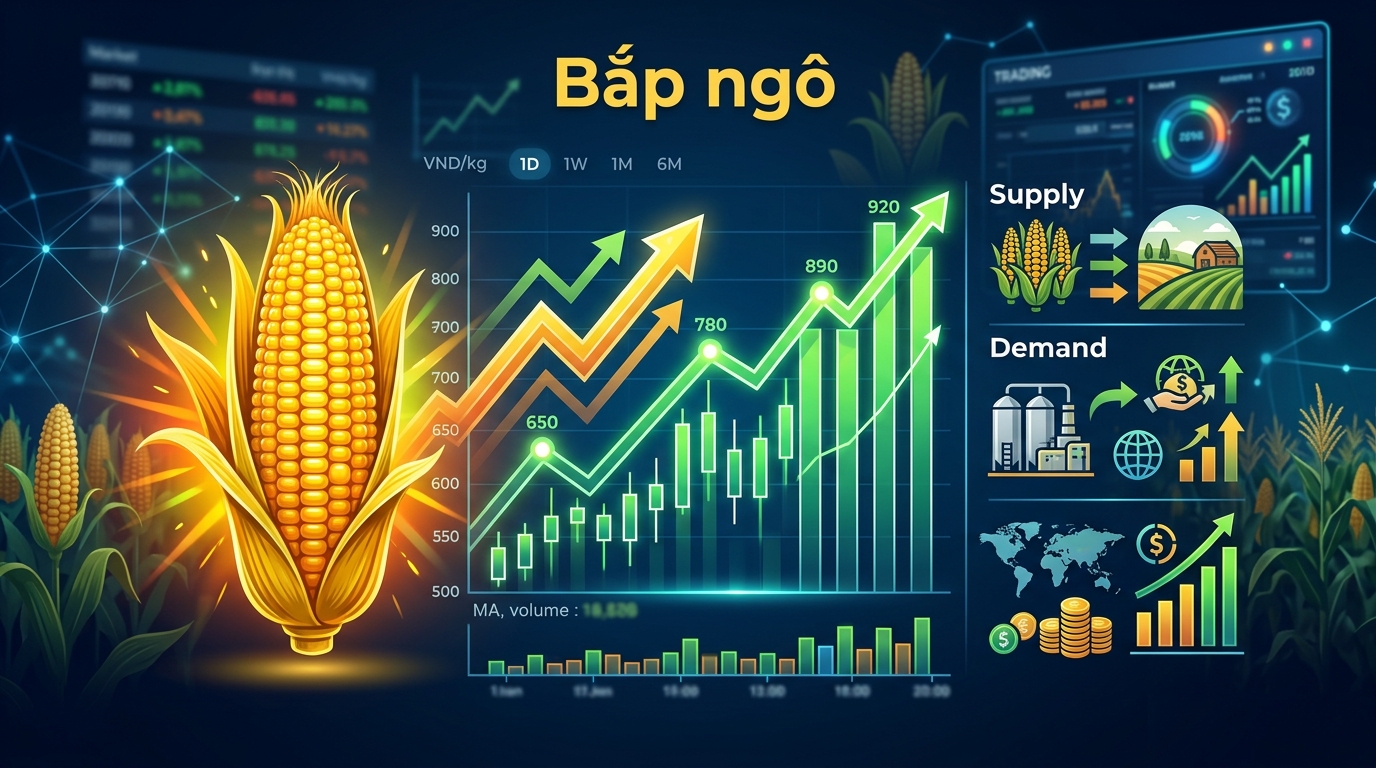
Entering November 2026, the international agricultural market, particularly corn, continues to witness notable volatility as seasonal factors from North America and the global macroeconomic landscape exert intertwined influences. Following a period of strong selling pressure in October, corn prices globally between November 1, 2026, and the end of November 2026 are showing clear signs of cooling and establishing a temporary equilibrium zone around a key technical support level.
Overview of Global Corn Price Movements in November 2026
According to market data as of November 22, 2026, corn prices traded on the Chicago Board of Trade (CBOT) were recorded at 434.50 UScents/bu (equivalent to approximately 4,413,449 VND/ton), maintaining a stable sideways trend with a slight fluctuation of +0.058% compared to the previous trading session. However, looking at the broader picture for November, the price level has decreased significantly compared to the previous month.
Specifically, the average price for November 2026 currently stands at 442.56 UScents/bu (approximately 4,495,318 VND/ton), a deep decline from the average price of 474.57 UScents/bu (about 4,820,461 VND/ton) in October 2026. The trading range over the past 30 days has fluctuated between 434.50 and 456.00 UScents/bu (equivalent to 4,413,449 - 4,631,836 VND/ton).
Notably, developments in the last 10 days clearly reflect the downward price pressure:
- From November 13 to November 17, 2026, corn prices hovered around the 445.50 - 448.51 UScents/bu range (approximately 4,525,000 - 4,555,000 VND/ton).
- By the period from November 18 to November 22, 2026, prices adjusted rapidly downward to the floor of 434.50 - 435.28 UScents/bu, setting the lowest level in the past 30-day cycle.
Corn Market in Vietnam: Recovering Demand but Cautious Sentiment
Vietnam is one of the world's leading corn importers to serve the animal feed production industry. The cooling of international corn prices in November 2026 has had a dual impact on the domestic market:
Regarding selling prices and import supply: The price of imported corn arriving at Vietnamese ports (Cai Mep, Phu My, or Hai Phong) in the second half of November recorded a decline corresponding to CBOT prices, fluctuating around 5,800 - 6,200 VND/kg depending on quality and delivery terms (including ocean freight, insurance, and storage costs). The decline in global prices helps animal feed factories reduce input material costs after months of facing high cost pressures.
Consumption demand: The fourth quarter of each year is the peak period for livestock farming to serve the Lunar New Year market. The demand for corn kernels as an ingredient for mixing animal and poultry feed remains high. However, domestic animal feed processing enterprises still maintain a cautious purchasing sentiment, mainly finalizing spot contracts or short-term futures, avoiding excessive inventory accumulation due to concerns over USD/VND exchange rate volatility and the prospect that global supply will continue to remain high in the coming months.
Analysis of Corn Price Volatility Factors
The decline in corn prices from the 474 UScents/bu level in October to near 434 UScents/bu in the second half of November 2026 stems from a combination of fundamental supply and demand factors:
1. Bumper Harvest Progress in the US
November is the time when US farmers enter the final stage of the 2026 corn harvest. Crop progress reports show that actual yields in the Corn Belt reached or exceeded initial expectations thanks to relatively favorable weather during the grain-filling stage. The pressure of abundant supply from the new harvest pushed commercial inventory levels high, forcing traders to lower offer prices to free up storage capacity.
2. Smooth Planting Progress in South America
In Brazil and Argentina – the two largest export competitors of the US – timely scattered rains in early November eased drought concerns, creating favorable conditions for planting the first corn crop and soybeans. The positive outlook for the 2027 Safrinha (second crop) corn season has extinguished speculation of price increases due to weather risks, putting downward pressure on the futures market.
3. Intense Competition in the Export Market
Market share competition between major exporters in the Black Sea region and South America has kept FOB export offer prices continuously suppressed. International buyers, especially China and Southeast Asian countries, are taking advantage of the abundant supply to delay large-volume purchases, forcing exporters to offer further price discounts.
Impact of Macroeconomic Factors
Beyond physical supply and demand factors, the global macroeconomic picture in November 2026 plays a core role in shaping agricultural price trends:
USD Index (DXY) Maintains Strength
The cautious monetary policy of the US Federal Reserve (Fed) in maintaining benchmark interest rates to curb inflation has kept the USD at a high level against a basket of currencies. As the USD strengthens, commodities priced in the greenback, such as corn, become more expensive for importing countries using local currencies. This reduces natural purchasing power in the international market, creating direct downward pressure on the CBOT.
Energy Market and Bioethanol Industry
Global crude oil prices in November 2026 remained relatively stable without any sharp spikes. Because a large portion of corn production (about 35-40% in the US) is used to process bioethanol for gasoline blending, the sideways crude oil price has constrained profit margins for ethanol plants, thereby reducing the demand for industrial corn procurement.
Logistics Costs and Supply Chain Risks
Although international shipping costs in November 2026 have stabilized compared to previous fluctuations, maritime route risks and transport insurance costs remain significant. This creates a divergence: corn prices at the export port (FOB) tend to decrease, but prices delivered to importers (CFR) in consuming markets like Vietnam do not decrease correspondingly due to the burden of circulation costs.
Assessment and Recommendations for Businesses
The stagnation of global corn prices at the 434.50 UScents/bu level on November 21 - 22, 2026, indicates that the market is testing a very strong technical support zone. It is likely that prices will enter an accumulation phase and fluctuate within a narrow range of 430 - 445 UScents/bu through the end of November 2026 as selling pressure from the US harvest gradually wanes.
For animal feed production enterprises and agricultural traders in Vietnam:
- Purchasing strategy: This is an appropriate time to consider partial disbursement for orders to be delivered in the first quarter of 2027. Waiting for prices to drop deeper below 430 UScents/bu may carry risks as the market begins to shift its attention to extreme weather fluctuations in South America early next year.
- Exchange rate risk management: The USD/VND exchange rate is expected to remain volatile at the end of the year; businesses need to combine currency derivatives with commodity futures contracts to lock in input costs.
- Optimization of alternative material sources: Continue to closely monitor the price spread between corn, feed wheat, and broken rice to have a flexible mixing formula, maximizing production profit margins.
In general, November 2026 closes with a relatively more "comfortable" corn price level for the livestock industry after a period of strong volatility. The ability to establish a new trend will depend largely on weather developments in South America and supply-demand parameters in upcoming periodic crop reports.