 Deutsch
 English
 Español
 Français
 Bahasa Indonesia
 日本語
 한국어
 Nederlands
 Português
 Tiếng Việt
 中文
Rice Market in November 2026: Establishing an 18.57 USD/CWT Peak and Global Food Security Challenges
AI Report · Rice
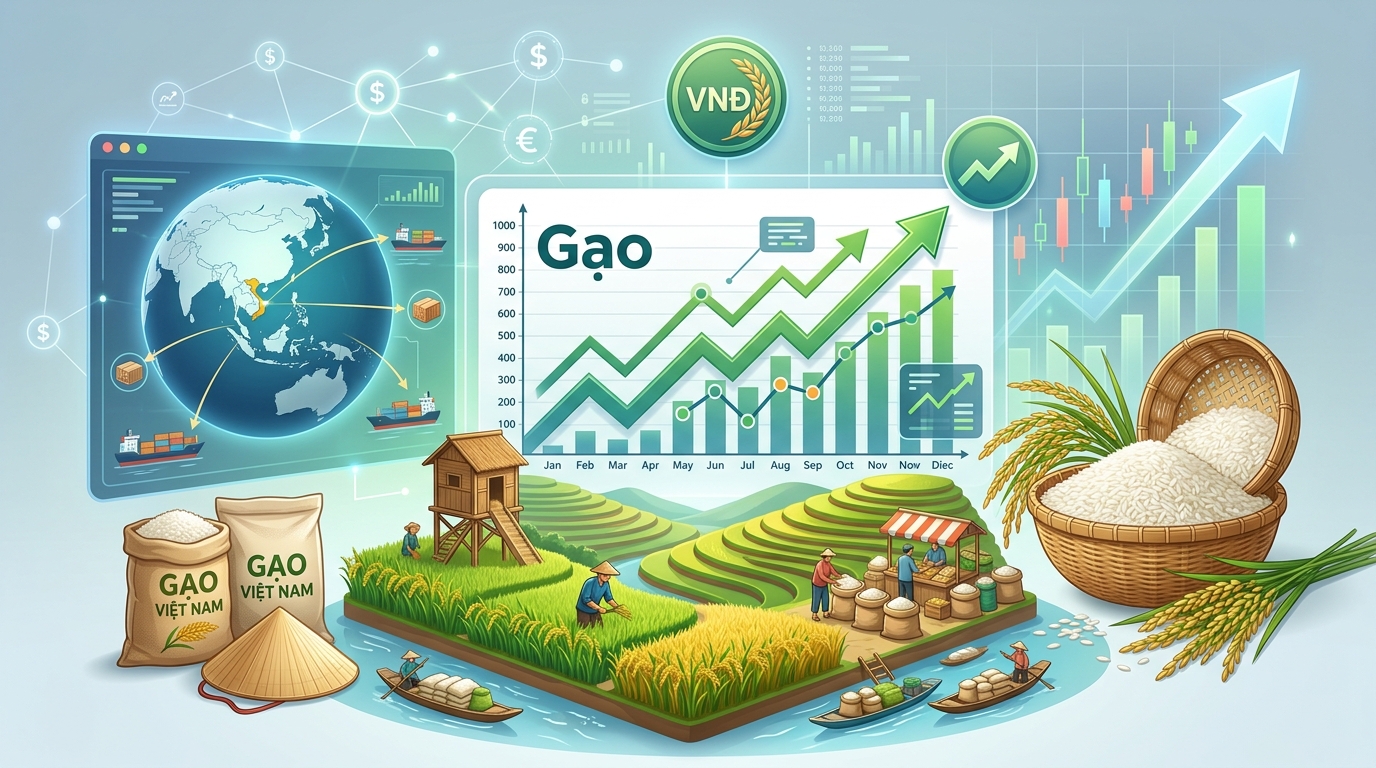
Entering the final stage of 2026, the international agricultural market, particularly the essential food segment, continues to witness notable fluctuations. Throughout November 2026, global rice prices maintained a strong recovery trend and are now entering a period of consolidation, establishing a new price floor at the month's peak. In the Vietnamese market, as well as on international commodity futures exchanges, the pressure of supply-demand balancing and the multi-dimensional impact of macroeconomic factors are creating a landscape that is both vibrant and fraught with challenges for participants across the value chain.
Overview of domestic and global rice price trends in November 2026
According to international futures trading data updated on November 23, 2026, rice prices for benchmark contracts are anchored at 18.57 USD/CWT (equivalent to approximately 10,560,249 VND/ton). Recent developments indicate that the market is shifting toward a state of stability following the previous breakout. The increase in the most recent session was a modest +0.32% (+0.06 USD/CWT, equivalent to an increase of 33,561 VND/ton).
Looking back at the entire journey in November 2026, the global rice market has undergone a clear recovery:
- Average price for November 2026: Reached 18.10 USD/CWT (approximately 10,295,745 VND/ton), a significant increase compared to the October 2026 average of 17.05 USD/CWT (9,698,478 VND/ton). The average difference of more than 1 USD/CWT reflects a positive shift in price expectations among international investors and traders.
- 30-day trading range: Fluctuated from a low of 17.02 USD/CWT (9,681,982 VND/ton) to a peak of 18.57 USD/CWT (10,560,249 VND/ton). This shows that cash flow has consistently absorbed the volume of goods sold, pushing prices to their highest level in the past month.
- Recent price trend: After testing the 18.21 USD/CWT mark on November 16, 2026, and 18.26 USD/CWT on November 17-18, 2026, rice prices jumped to 18.57 USD/CWT starting November 19, 2026, and have continuously maintained an accumulation state around this level through November 23, 2026.
In Vietnam, the domestic market in the Mekong Delta has also recorded parallel movements. Supply of the Autumn-Winter crop is tightening toward the end of the season, while traders and exporters are actively collecting stock to fulfill orders for delivery in the fourth quarter of 2026. Prices for fresh paddy of high-quality varieties such as OM18, Dai Thom 8, ST24, and ST25 continue to remain high, providing positive support for farmers' income but simultaneously creating profit margin pressure for exporters who have not yet signed new contracts at high prices.
Analysis of factors driving price growth and accumulation
The shift of global rice prices from the low of 17.02 USD/CWT to the peak of 18.57 USD/CWT in November 2026 stems from the convergence of several key factors related to the supply-demand cycle and year-end procurement activities:
1. Peak reserve demand ahead of the festive season
November of each year is always a critical time for major rice-importing countries in Asia and Africa to increase purchases. Vietnam's traditional partners, such as the Philippines and Indonesia, have continuously pushed to open tenders and receive shipments for delivery in late 2026 to ensure national food reserves for the Lunar New Year and the beginning of 2027. The pressure from international traders to meet delivery schedules has created solid support, driving futures prices upward.
2. Supply transition between two production seasons
In major Asian rice bowls, including Thailand and Vietnam, November is a transitional period. The Summer-Autumn and Autumn-Winter crops have passed their peak harvest stage, while the main 2026-2027 Winter-Spring crop is still being sown and cannot be harvested early. This "temporary supply gap" has caused available inventory in the spot market to decrease, forcing importers to pay higher prices to secure immediate delivery.
3. Cautious sentiment regarding regional export regulations
Market management moves by India continue to be a focal point for the international trade community. Although the country has taken certain steps to relax exports in 2026, regulations on Minimum Export Prices (MEP) and safeguard tariffs are still being carefully considered to curb domestic inflation. Any information related to tightening or loosening has a direct impact on the global CWT rice trading board, preventing prices from falling sharply.
Impact of macroeconomic factors on the rice market
Beyond being governed by the internal supply-demand equation of the agricultural sector, rice prices in November 2026 are also deeply influenced by macroeconomic variables on a regional and global scale:
Monetary policy and the USD trend
Agricultural commodities priced in US Dollars are always sensitive to the DXY index. In November 2026, the cautious steps taken by the US Federal Reserve (Fed) in its interest rate path have caused the USD to maintain relative strength. This makes the cost of food imports in local currencies more expensive in many developing countries. However, rice demand is an essential need that is difficult to cut, so buyers are still forced to accept the new price level, contributing to keeping rice futures anchored firmly at 18.57 USD/CWT.
Ocean freight costs and input material prices
Geopolitical tensions along several international shipping lanes have not yet fully cooled, keeping ocean freight rates and fuel surcharges at high levels in the second half of 2026. Simultaneously, fertilizer prices and fuel costs for cultivation have tended to rise slightly in line with the year-end cycle. Higher production costs at the farm gate force farmers and cooperatives to offer higher prices for raw paddy to ensure profitability, thereby forming a natural price floor for the entire supply chain.
Climate change and extreme weather risks
Weather in the fourth quarter of 2026 recorded many unusual patterns in the Asia-Pacific region. The appearance of late tropical storms and uneven rainfall distribution has raised concerns about the yield of the new crop in some coastal areas. The risk factor of natural disasters is always a catalyst that leads analysts to forecast that supply will struggle to reach a large surplus, thereby stimulating speculative hoarding behavior in financial markets.
Trend outlook and strategic recommendations
The period from November 19 to November 23, 2026, with 5 consecutive sessions of rice prices remaining stagnant at 18.57 USD/CWT, shows that the market is in a pause phase to find a new equilibrium point. The possibility of a strong breakout above the 19.00 USD/CWT mark in the short term is not very high without additional unexpected news regarding weather or sudden policy changes from major exporting nations.
Based on the current context, market participants should pay attention to the following key points:
- For exporters: Extreme caution is needed when signing long-term contracts for early 2027 without guaranteed reciprocal supply. In a context where domestic raw rice prices are anchored close to export prices, using commodity derivatives or negotiating open contracts (price calculated at the time of delivery) is the optimal way to manage profit margin risks.
- For cooperatives and farmers: The current time is a good opportunity to release late-crop paddy at a highly profitable price. At the same time, it is necessary to focus on well-preparing cultivation techniques for the 2026-2027 Winter-Spring crop to optimize seed and fertilizer costs and adapt to water supply conditions.
- For commodity investors: The 18.57 USD/CWT price level fully reflects the positive news of November. It is necessary to closely monitor the support level of 18.20 USD/CWT and the resistance level of 18.80 USD/CWT to have a reasonable trading strategy as the market enters the final trading week of November 2026.
In general, the rice market in November 2026 has successfully completed an impressive recovery compared to October. The stability of rice prices not only affirms the strategic position of Vietnamese and global rice in the food security balance but also requires businesses to have a flexible vision, anticipating macroeconomic impulses to maintain business efficiency during the year-end trading season.