 Deutsch
 English
 Español
 Français
 Bahasa Indonesia
 日本語
 한국어
 Nederlands
 Português
 Tiếng Việt
 中文
Commodity Market Summary Report for the Week of Nov 16, 2026 - Nov 22, 2026: Geopolitical Tensions Keep Energy and Metal Prices Elevated
AI Market Digest
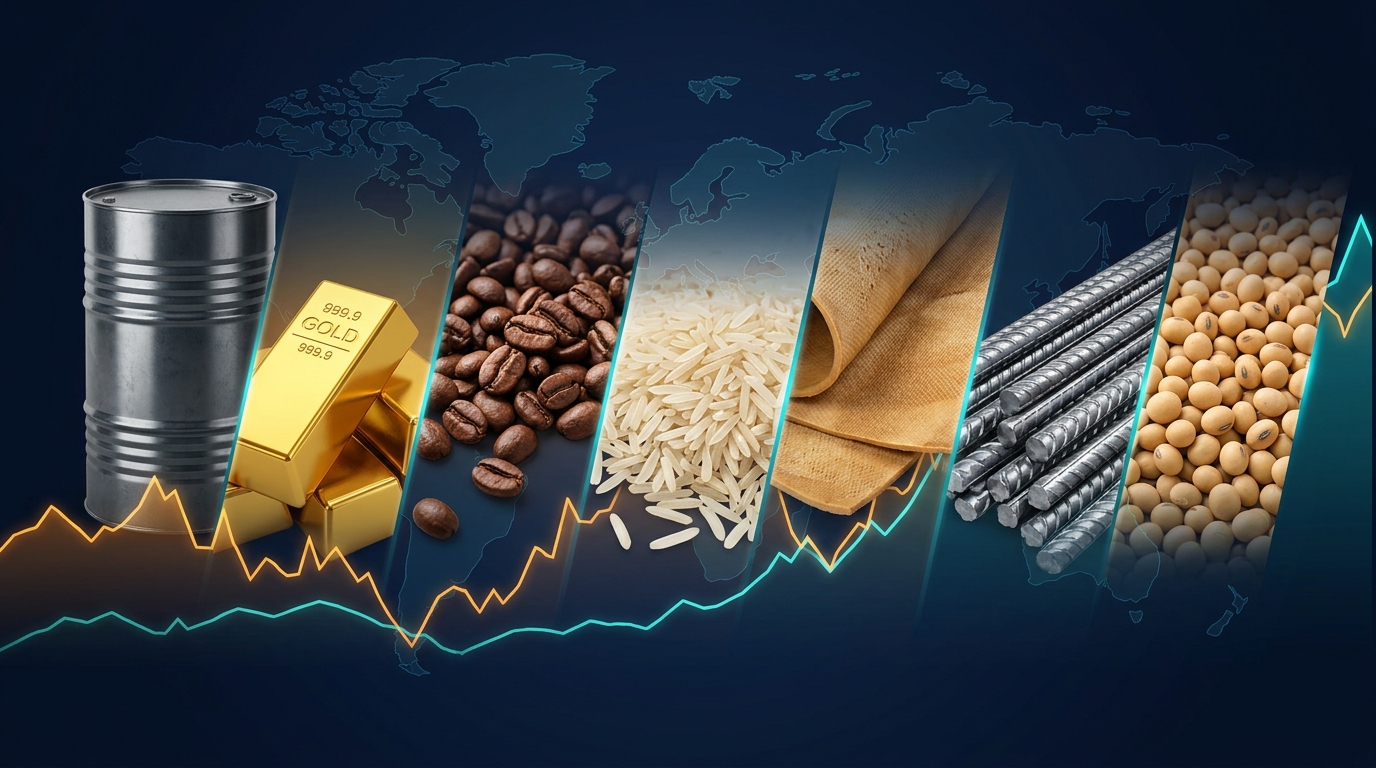
The global commodity market for the week of November 16, 2026, to November 22, 2026, recorded a clear divergence as geopolitical hotspots in the Middle East and Eastern Europe continued to dictate investor sentiment. The escalating tensions in the Persian Gulf following the attack on a US Patriot radar system in Bahrain by missiles and unmanned aerial vehicles (UAVs), combined with large explosions near Russia's Baltic Fleet base, have established a firm price floor for energy and precious metals. Simultaneously, complex diplomatic developments between the US and China following President Donald Trump's visit to Shenzhen have introduced unpredictable variables for global trade and industrial raw material supply chains.
Agricultural Products
International agricultural prices maintained a sideways consolidation range over the past week, while Vietnam's agricultural exports received positive signals from emerging markets. Notably, Vietnamese 5% broken rice held at 413.90 USD/ton (equivalent to approximately 10.68 million VND/ton), continuing to compete well against Thai 5% broken rice at 489.00 USD/ton and Thai 25% broken rice at 472.00 USD/ton. A major driver for Vietnam's rice and agricultural export industry has come from the African region, with import growth surging by over 1,600% among several key partners, opening up significant consumption potential for the year-end period.
The Robusta coffee market closed the week at 2,881.00 UScents/kg (approximately 743.34 million VND/ton), continuing to maintain a high price floor despite cooling from the monthly average of 3,153.36 UScents/kg. Meanwhile, coffee prices for Arabica reached 268.50 UScents/lb (approximately 152.73 million VND/ton), fluctuating slightly by +0.07% during the week. New crop coffee supply from the Central Highlands has begun to enter the peak harvest phase, but selling pressure remains limited as domestic farmers and agents are proactively holding stock in anticipation of a price recovery.
The global grain and animal feed ingredient group recorded a slight recovery, helping to ease input cost pressures for Vietnam's livestock industry. Wheat prices rose 2.87% to 592.00 UScents/bushel (approximately 5.61 million VND/ton), while SRW wheat reached 574.25 USD/ton. Soybeans closed the week at 1,220.80 UScents/bushel (approximately 11.57 million VND/ton), corn maintained its level at 434.50 UScents/bushel (approximately 4.41 million VND/ton), and soybean meal reached 340.30 USD/short ton. The fertilizer market remained stable, with urea at 426.50 USD/ton (approximately 11.00 million VND/ton) and DAP at 790.00 USD/ton (approximately 20.38 million VND/ton), creating favorable conditions for farmers to prepare for the Winter-Spring crop.
Outlook for next week: The agricultural group is expected to continue fluctuating within a narrow range; specifically, Vietnam's rice and coffee exports will maintain good liquidity thanks to year-end festive season demand from the international market.
Metals
The precious metals market continues to be firmly supported by safe-haven demand in the face of military conflicts in Eastern Europe and the Middle East. Gold prices closed the week at 3,535.00 USD/ounce (equivalent to approximately 109.97 million VND/tael), fluctuating slightly by +0.06% compared to the previous session, though still lower than the monthly average of 3,886.32 USD/ounce due to short-term profit-taking pressure. Silver prices anchored at 41.19 USD/ounce (approximately 1.28 million VND/tael), and platinum held at 1,289.60 USD/ounce.
The base metals group showed divergent movements as global economic growth and US-China trade relations face new challenges. Copper futures reached 548.50 UScents/lb (approximately 312.00 million VND/ton), edging up +0.37% but still under pressure compared to the monthly average of 607.12 UScents/lb. The diplomatic-trade friction arising immediately after former President Donald Trump's visit to Shenzhen is raising concerns about new tariff barriers on industrial metals.
Iron ore and metallurgical metals maintained a defensive stance as the regional real estate market has yet to see a major breakthrough. 62% Fe iron ore ended the week at 90.67 USD/dmtu (equivalent to 2.34 million VND/dmtu). Aluminum reached 2,839.80 USD/ton (approximately 73.27 million VND/ton), zinc reached 3,480.80 USD/ton, and nickel stood at 15,375.00 USD/ton. In Vietnam, efforts to accelerate public investment disbursement for major infrastructure projects, such as the Ben Thanh - Tham Luong - Thu Dau Mot metro line or the progress of the North-South expressway packages, are partially supporting domestic demand for steel and construction materials.
Outlook for next week: Gold and silver prices will continue to maintain their tripod stance at peak levels as geopolitical tensions show no signs of cooling; meanwhile, industrial metals like copper and aluminum will be subject to volatility based on trade policy rhetoric.
Energy
The global energy market maintains high price levels due to fears of potential disruptions to oil transport through the critical Strait of Hormuz. Brent crude oil closed the week at 92.57 USD/barrel (approximately 2.39 million VND/barrel), WTI crude traded at 83.41 USD/barrel (approximately 2.15 million VND/barrel), and Dubai crude reached 91.38 USD/barrel. The aerial attack on defense radar stations in Bahrain has fueled persistent concerns about the conflict spreading in the Gulf, a vital transit artery for global oil flows.
The natural gas market is heating up significantly ahead of a harsh winter and instability in the Baltic Sea region. US natural gas rose 1.59% to 3.41 USD/mmbtu (equivalent to approximately 3,248 VND/m³), while European natural gas prices remained very high at 28.50 USD/mmbtu (approximately 27,139 VND/m³), and LNG delivered to Japan reached 28.41 USD/mmbtu (+3.23%). Explosions and UAV warnings near Russia's Baltic Fleet base have placed subsea gas pipelines on high alert, putting pressure on EU gas supplies.
International coal prices remain stable around high levels to meet heating season demand for thermal power. Coal reached 144.95 USD/ton (equivalent to 3.74 million VND/ton, up +1.26%), and South African coal closed the week at 127.30 USD/ton. For Vietnam, high global energy prices continue to pose challenges regarding the cost of imported petroleum and fossil fuels, accelerating the trend toward developing renewable energy and waste-to-energy sources (such as the 1.15 trillion VND waste-to-electricity plant project recently completed).
Outlook for next week: Crude oil and natural gas will maintain an upward trend or remain elevated as security risks in the Middle East and Eastern Europe remain unresolved; Brent is expected to fluctuate around the 90 - 95 USD/barrel mark.
Food
Global protein and fresh meat prices recorded relatively stable performance with a sideways trend. Pork prices closed the week at 52.60 UScents/lb (equivalent to approximately 29.92 million VND/ton), lower than the monthly average of 54.90 UScents/lb, reflecting abundant supply from major North American exporters. Beef prices in Brazil reached 395.50 BRL/kg (approximately 1.63 billion VND/ton), and chicken reached 8.33 BRL/kg (approximately 34.41 million VND/ton).
The domestic food market in Vietnam's major cities maintains a stable supply, with no signs of local shortages. The fact that imported animal feed costs (corn, soybean meal) have remained stable for many weeks has helped livestock households and businesses restock sustainably, ensuring an abundant supply of pork and poultry in preparation for the upcoming Tet holiday.
Outlook for next week: The global food group is not expected to see major price shocks; domestically, live hog prices are expected to trend slightly upward in line with year-end seasonal patterns.
Notable Commodity Movements of the Week
- Brent Crude (92.57 USD/barrel) and WTI Crude (83.41 USD/barrel): Maintained very high price levels amid military hotspots in Bahrain and the Strait of Hormuz, which are continuously issuing maritime transport risk warnings.
- Gold (3,535.00 USD/ounce): Continued to maintain its position as the most expensive safe-haven asset, reflecting the anxiety of international capital flows in the face of UAV attacks in the Baltic region and internal EU divisions over financial aid packages.
- Wheat (592.00 UScents/bushel, +2.87%): Recorded the strongest recovery in the agricultural group last week due to increased import demand from North African and Asian countries.
- Vietnamese Rice Exports: Recorded a breakthrough signal from the African market (with local import growth of over 1,600%), helping to consolidate the price of Vietnamese 5% broken rice at 413.90 USD/ton.
Forecast and Recommendations for the Week of Nov 23, 2026 - Nov 29, 2026
The general trend of the commodity market in the coming week will continue to be strongly influenced by geopolitical factors rather than pure supply-demand balances. The energy and precious metals groups are expected to maintain their leading strength; the agricultural and base metals groups are likely to consolidate sideways while awaiting clearer signals on international trade policy.
Vietnamese import-export businesses and investors need to pay special attention to the following key risk factors:
- War and maritime risks: Escalating developments in the Persian Gulf and the Strait of Hormuz could cause shipping rates (containers and oil tankers) to spike, directly affecting the profit margins of export businesses.
- US-China trade risks: Trade policy moves following Donald Trump's visit to China should be closely monitored to guard against new tariff barriers on the processing material supply chain.
- Inventory management recommendations: Businesses using energy and metals should proactively lock in forward contracts to hedge input costs; rice and agricultural businesses should take advantage of the new wave of orders from the African market while strictly controlling international payment risks.
Share this insight: