 Deutsch
 English
 Español
 Français
 Bahasa Indonesia
 日本語
 한국어
 Nederlands
 Português
 Tiếng Việt
 中文
Commodity Market Summary Report for the Week of November 9, 2026 - November 15, 2026: Energy and Metals Remain Elevated Amid Geopolitical Tensions
AI Market Digest
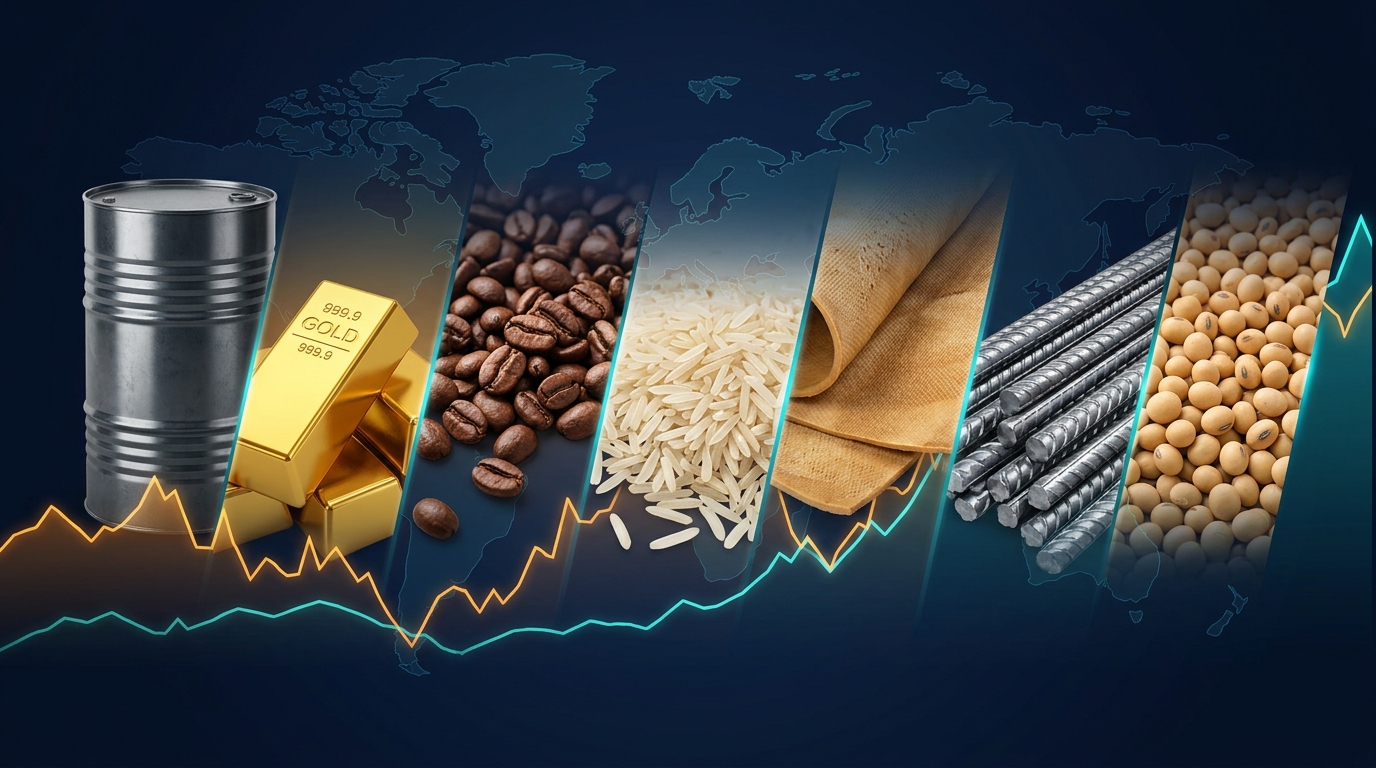
The commodity market for the week of November 9, 2026 - November 15, 2026, maintained stability with a slight upward trend across most sectors, primarily driven by rising geopolitical risks in the Middle East and Eastern Europe. The conflict escalated after Iran announced an attack on a U.S. base, prompting the Bahraini air defense system to engage, while Russia's hardline stance toward Europe and NATO pushed capital toward safe-haven assets, especially as risk assets like Bitcoin recently hit a 3-month low. In Vietnam, domestic economic activity showed signs of growth, highlighted by the breakthrough of the first tunnel in the De Ca Group's infrastructure project worth over 26.18 trillion VND, while the commercial banking system (Vietcombank, BIDV, VPBank, etc.) recorded a wave of increased foreign capital mobilization to stabilize year-end liquidity.
Agricultural Products
The global agricultural market recorded slight price increases and remained stable over the past week. Specifically, as of November 15, 2026, coffee prices for Arabica closed at 273.50 UScents/lb (approximately 155.1 million VND/ton, up 0.18%), while Robusta coffee held at 3,210.00 UScents/kg (approximately 825.8 million VND/ton, up 0.44%). Grain prices saw narrow fluctuations, with soybeans reaching 1,231.50 UScents/bu (up 0.11%), corn at 445.50 UScents/bu (up 0.11%), and wheat at 593.25 UScents/bu (up 0.04%). Natural rubber on the Japanese exchange maintained the 246.90 JPY/kg mark (up 0.12%), while TSR20 rubber reached 250.20 USD/kg (up 0.72%).
The primary driver for the stability in the agricultural sector stems from rising input costs and global supply chain tensions. Fertilizer prices recorded an upward trend, with urea reaching 429.00 USD/mt (approximately 11.04 million VND/ton, up 0.70%) and DAP rising to 790.00 USD/mt (approximately 20.32 million VND/ton, up 0.63%). Regarding rice, Vietnam's 5% broken rice held at 413.90 USD/mt, maintaining its competitive edge against Thai 5% rice (489.00 USD/mt). In Vietnam, the demand for raw material procurement for year-end processing is gradually increasing, supporting a solid foundation for agricultural prices.
The trend for the agricultural sector next week is expected to continue moving sideways, closely influenced by developments in maritime transport costs and international oil prices.
Metals
Prices for precious and base metals simultaneously consolidated at high levels during the week ending November 15, 2026. Global gold prices closed the week at 3,881.80 USD/toz (equivalent to approximately 120.4 million VND/tael, up 0.04%), remaining near highs as capital flowed out of volatile cryptocurrency and stock markets. Silver rose to 48.72 USD/toz (approximately 1.51 million VND/tael), and platinum held at 1,489.70 USD/toz. In the industrial metals group, copper rose 0.33% to 607.95 UScents/lb (approximately 344.8 million VND/ton), tin rose sharply by 0.53% to 46,897.00 USD/mt, aluminum reached 3,009.00 USD/mt, and 62% Fe iron ore settled at 91.48 USD/dmtu.
Escalating military tensions in the Middle East are the biggest support for precious metals to maintain their safe-haven appeal. Additionally, breakthroughs in battery technology and new transport vehicles—exemplified by the first manned test flight of a Chinese electric aircraft equipped with CATL batteries—are opening up strong consumption prospects for copper, aluminum, and refined metals. In the domestic Vietnamese market, the progress of large-scale transport infrastructure projects like the De Ca series continues to create real demand for construction steel and base metals.
The forecast for next week is that precious metals will maintain a slight upward trend due to risk-aversion sentiment, while industrial metals will fluctuate depending on China's economic outlook.
Energy
Energy prices last week recorded a clear acceleration due to concerns over supply disruptions. Brent crude oil closed the session on November 15, 2026, at 95.84 USD/barrel (equivalent to 2.47 million VND/barrel, up 0.25%), while WTI oil reached 88.56 USD/barrel (approximately 2.28 million VND/barrel, up 0.40%) and Dubai crude oil rose sharply by 1.79% to 93.81 USD/barrel. In the gas market, natural gas in the U.S. traded at 3.23 USD/mmbtu (+0.37%), while Japanese LNG surged 5.91% to 31.35 USD/mmbtu. Global coal prices also recorded a 1.97% increase to 145.25 USD/mt.
Military pressure in the Persian Gulf, as Bahraini air defenses engaged following an attack announcement from Iran, pushed the risk premium for crude oil transport higher. Simultaneously, Russia's firm stance on energy and military strategy leaves Europe facing a tense winter gas storage situation. Increased heating demand in Northeast Asia triggered the surge in Japanese LNG (+5.91%), while also supporting global thermal coal prices.
Next week, the energy market is expected to face high volatility based on news of military developments in the Gulf, with Brent oil likely to retest the 98.00 USD/barrel resistance level.
Food
Prices for animal protein products in the global market maintained a slight, stable increase in line with Q4 consumption trends. Beef on the Brazilian exchange recorded a price of 394.15 BRL/kg (approximately 1.63 billion VND/ton, up 0.22%), while chicken settled at 8.15 BRL/kg (up 0.12%). Pork in the U.S. market closed the week at 55.45 UScents/lbs (approximately 31.45 million VND/ton, up 0.18%).
The demand for preparing food supplies for the year-end festive season in major markets is the main driver supporting this slight price increase. However, the growth margin remains controlled because animal feed costs (soybean meal 329.80 USD/ust, corn 445.50 UScents/bu) were relatively stable last week, causing no sudden pressure on global livestock production costs.
For next week, the food group is expected to remain at current price levels with stable purchasing power from both retail and food service markets.
Notable Commodity Fluctuations of the Week
- Japanese LNG (+5.91%): Surged to 31.35 USD/mmbtu as North Asian countries ramped up heating fuel stockpiles ahead of cold fronts and risks of maritime route disruptions in the Middle East.
- Dubai Crude Oil (+1.79%) & Coal (+1.97%): Reached 93.81 USD/barrel and 145.25 USD/mt respectively, directly reflecting the primary energy supply response to threats against Gulf security.
- Global Gold (3,881.80 USD/toz): Firm at historical highs as global capital seeks value-preserving assets amidst Bitcoin's 3-month low and spreading military conflict.
- Tin (+0.53%): Rose to 46,897.00 USD/mt on expectations of positive progress in demand for electronic components and new technology aviation.
Forecast and Recommendations for the Week of November 16, 2026 - November 22, 2026
Commodity price trends for the coming week are expected to show a clear divergence between the energy-precious metals group (leaning toward growth) and the agricultural-food group (leaning toward accumulation). Oil and precious metal prices will be the focal point, directly influenced by military retaliation in the Gulf. Domestically, the adjustment of interest rate schedules by major banks and the expansion of foreign capital absorption will continue to support import-export businesses in managing cash flow for raw material procurement.
Vietnamese businesses and investors should note the following key risk factors:
- Middle East Military Conflict: Closely monitor the actions of Iran and Bahraini air defense forces, as any incident involving the Strait of Hormuz could trigger a surge in oil prices and shipping rates.
- Russia-NATO Geopolitical Tensions: Strategic documents and diplomatic rifts could create unpredictable volatility for the grain and fertilizer markets.
- Domestic Logistics Cost Fluctuations: Leverage positive signals from transport infrastructure and foreign currency credit packages to balance raw material inventories such as steel, plastic resins, and fertilizers before the peak production season.
Share this insight: