 Deutsch
 English
 Español
 Français
 Bahasa Indonesia
 日本語
 한국어
 Nederlands
 Português
 Tiếng Việt
 中文
Beef Market in October 2026: Growth Stalls at Record Highs Amid Global Supply Chain Pressures
AI Report · Beef
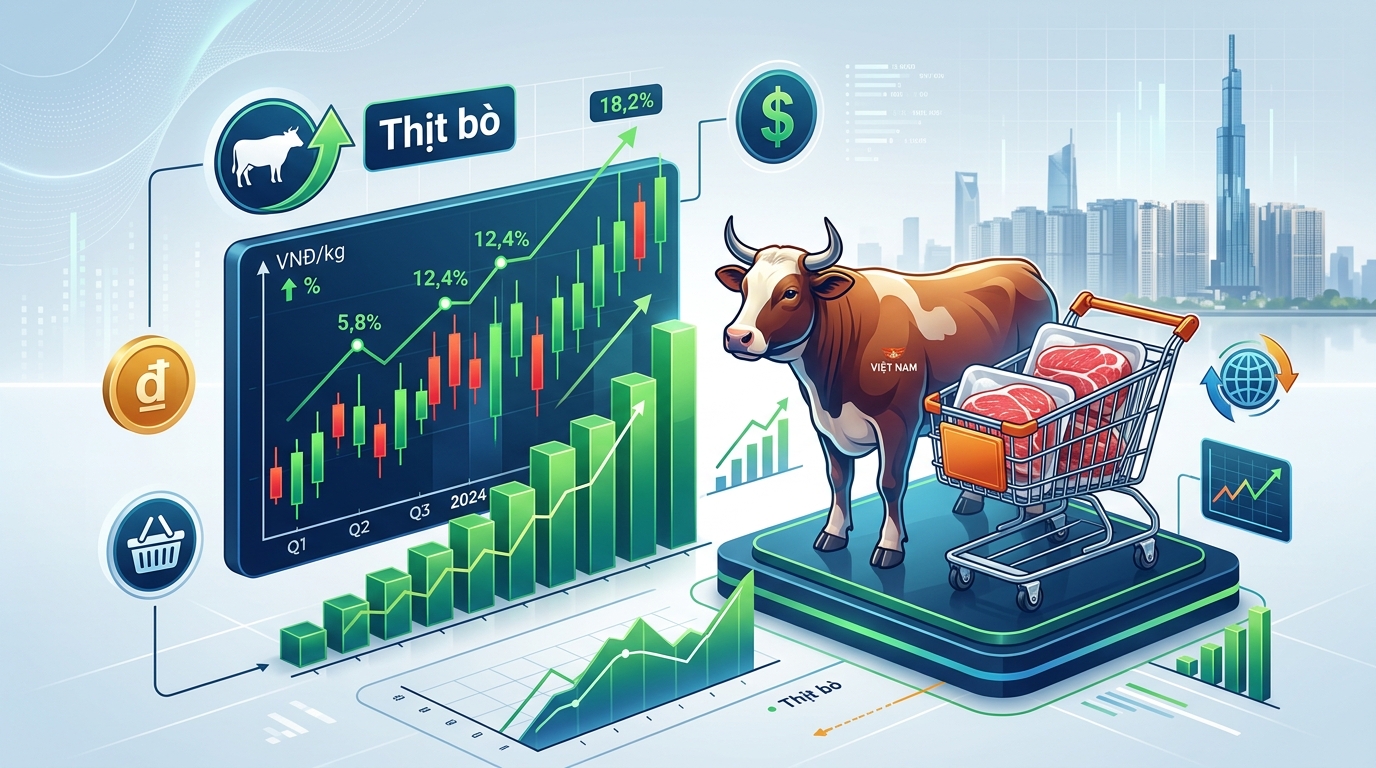
October 2026 marked significant shifts in the international food commodity market, with beef remaining a focal point for analysts and food processing enterprises. Following a robust growth trajectory that extended through the third quarter, the global beef market entered a consolidation phase at record-high price levels in October. Maintaining this new price floor not only reflects tightened supply from major exporters like Brazil and Australia but also poses a challenging cost dilemma for import-dependent nations, most notably Vietnam.
Overview of the Global and Vietnamese Beef Market in October 2026
International commodity trading data, particularly from the benchmark South American market (Brazil), indicates that beef prices are anchored at very high levels. As of the trading session on October 23, 2026, beef prices were recorded at 380.40 BRL/kg, equivalent to approximately 1,571,554,128 VND/ton. Although the volatility range in recent sessions has been largely flat (a change of only +0.013%, with a slight dip of -0.05 BRL from the short-term peak), the overall price level for the month has established a completely new benchmark.
Specifically, the average price for October 2026 reached 375.33 BRL/kg (approximately 1,550,608,336 VND/ton), a significant increase compared to the average of 352.72 BRL/kg (approximately 1,457,199,190 VND/ton) recorded in September 2026. The fluctuation range over the past 30 days spanned from 352.90 BRL/kg to 380.45 BRL/kg, reflecting persistent upward pressure in the first half of the month before entering a stable, sideways trend after October 20.
In the Vietnamese market, the price surge of imported beef raw materials has quickly permeated the domestic wholesale and retail markets. Domestic live cattle prices have hovered around 78,000 – 86,000 VND/kg depending on the region, while chilled and frozen beef imported from Brazil, Australia, and the US for supermarket chains and restaurants have also recorded increases of 5% to 8% compared to the previous month. The recovery of the food service industry and preparations for the year-end festive season are generating stable demand in major urban centers like Hanoi and Ho Chi Minh City.
Detailed Analysis of Fluctuations: From Rally to "Wait-and-See"
Observing the daily trading data in October 2026, market developments can be divided into two distinct phases:
- Acceleration Phase (October 01 to October 20): Starting from below 370 BRL/kg at the beginning of the month, beef prices quickly surpassed the 376.30 BRL/kg mark on October 08-09, then jumped to 377.80 BRL/kg (October 10-11) and hit 380.20 BRL/kg on October 16. By October 20, the price established its monthly peak at 380.45 BRL/kg (approximately 1,571,760,694 VND/ton). The primary driver of this phase was a wave of aggressive procurement by Asian importers to meet peak Q4 consumption demand.
- Consolidation and Sideways Phase (October 21 to October 23): The market reacted immediately as prices approached strong resistance. Over three consecutive sessions (October 21, 22, and 23), beef prices remained absolutely stable at the 380.40 BRL/kg mark. Trading volume showed signs of slowing as buyers became cautious in the face of record-high prices, while sellers faced no pressure to offload inventory due to safe stock levels.
This stability suggests that the market has temporarily found a short-term equilibrium, reflecting the tug-of-war between rising input costs and the limits of consumer purchasing power.
Core Causes of Beef Price Volatility
The sharp price increase from September to October and the maintenance of current high levels stem from a combination of technical factors and supply-demand market dynamics:
- Decline in Cattle Herds in Major Producing Countries: The restocking cycle in South America and North America is currently in a tightening phase. In Brazil, localized drought conditions during the middle months of 2026 reduced pasture quality, forcing farms to accelerate slaughtering in previous quarters, leading to a current shortage of export-standard beef cattle.
- Surging Import Demand Due to Seasonal Cycles: The fourth quarter is always a global peak consumption season. China, the world's largest consumer of Brazilian beef, has increased import quotas in preparation for the 2027 Lunar New Year. Similarly, Southeast Asian markets have stepped up frozen inventory reserves due to concerns over exchange rate volatility and ocean freight rates.
- High Breeding and Logistics Costs: Although grain prices for animal feed have cooled slightly compared to previous years, costs for veterinary medicine, farm heating/cooling energy, and refrigerated container shipping in October 2026 remain high, significantly increasing the production cost per kilogram of beef.
Impact of the Global Macroeconomic Context
The beef market does not operate in a vacuum but is strongly influenced by macroeconomic variables in October 2026:
1. Exchange Rate Fluctuations: The Brazilian Real (BRL) has maintained relative strength due to the Central Bank of Brazil's tight monetary policy aimed at controlling domestic inflation. As the BRL strengthens, beef prices in foreign currency terms become more expensive for trading partners, while pushing the conversion rate into Vietnamese Dong (VND) to a record high of over 1.57 billion VND/ton.
2. Food Inflation and Divergent Consumption Trends: Although global inflation in 2026 has gradually stabilized around central bank targets, the high food price level accumulated over many years continues to weigh on consumer spending. In emerging markets, consumers are beginning to segment: the mid-to-high-end segment maintains stable beef consumption, but the mass-market segment shows signs of shifting partially toward cheaper alternative protein sources such as poultry and pork.
3. Technical Barriers and Green Regulations: Stricter standards regarding deforestation-free livestock sourcing (such as the EUDR anti-deforestation law expanding to many markets in 2026) have significantly narrowed the supply of export-standard beef. Costs for inspection and traceability certification are being passed directly into product prices.
Year-End 2026 Outlook and Strategic Recommendations
Looking toward the end of October and into November-December 2026, the meteoric rise in beef prices is unlikely to continue as strongly as it did in early October. The market is expected to continue moving within a narrow range around 375.00 – 385.00 BRL/kg. The 380.45 BRL/kg resistance level has shown a clear cooling of purchasing power, and any breakout attempt will face profit-taking pressure or order delays from major importers.
For food import and processing enterprises in Vietnam, this is a pivotal time to review business strategies:
- Inventory Risk Management: Avoid the FOMO (fear of missing out) mentality of hoarding at price peaks. Businesses should consider signing flexible forward contracts or breaking down shipments to average out capital costs.
- Diversify Supply Sources: Leverage Free Trade Agreements (FTAs) to seek alternative beef sources from Australia or New Zealand to reduce dependence on BRL exchange rate volatility.
- Optimize Cold Chain: Improving storage efficiency and reducing post-slaughter losses is key to preserving profit margins in a context where input costs are unlikely to drop significantly in the short term.
In summary, October 2026 has established a new price floor for the global beef market. The ability to adapt flexibly to macroeconomic variables and proactive management of the value chain will be the deciding factors for the competitiveness of food enterprises during the peak year-end business season.