 Deutsch
 English
 Español
 Français
 Bahasa Indonesia
 日本語
 한국어
 Nederlands
 Português
 Tiếng Việt
 中文
Beef Market in November 2026: Anchored at Record Highs Amid Cost Pressures Ahead of Peak Consumption Season
AI Report · Beef
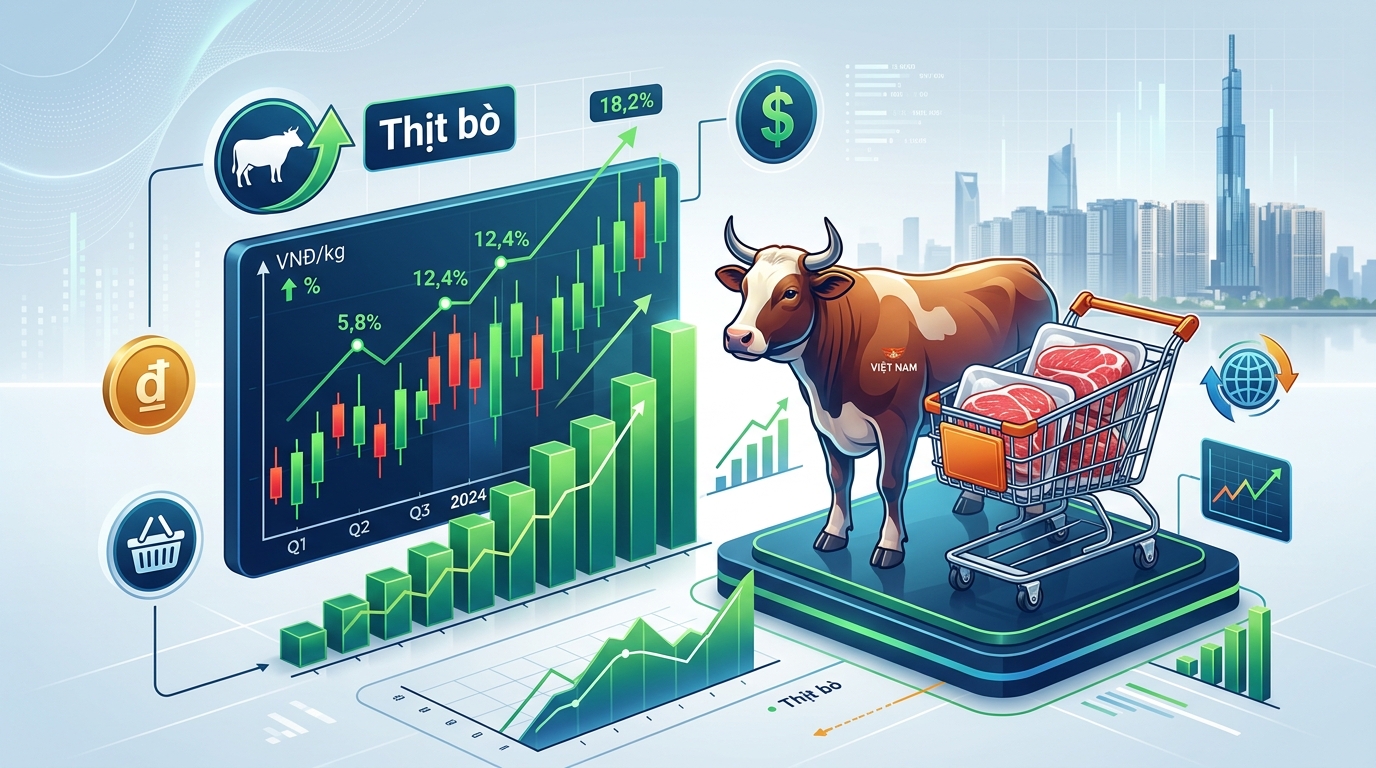
The global and domestic beef markets in November 2026 are witnessing highly notable developments as international trading prices continue to maintain a solid growth momentum, anchoring at the year's peak. The period from November 1, 2026, to November 30, 2026, marks a turning point as demand for food stockpiling for the year-end festive season begins to accelerate in key markets. Actual data shows that the market for beef raw materials exported from South America—specifically Brazil—is establishing a new price floor, directly and strongly impacting import costs as well as retail prices in the Vietnamese market.
Overview of Global Beef Price Data in November 2026
According to the latest updated figures as of November 17, 2026, beef prices on the international exchange reached 394.25 BRL/kg (equivalent to approximately 1,628,772,910 VND/ton). Although the increase in the most recent session reached only +0.29% and is considered stable, this is essentially a consolidation phase at the highest peak in the past 30-day cycle.
Looking back at the trading sequence from the beginning of November to date, the upward trend has been clearly defined:
- Early November: On November 8, 2026, the price was recorded at 392.70 BRL/kg (~1.622 billion VND/ton).
- Mid-month period: From November 11 to November 15, 2026, prices edged up and leveled off steadily at 394.15 BRL/kg (~1.628 billion VND/ton).
- Current (November 16 - 17, 2026): Prices continued to rise slightly by 0.10 BRL to the 394.25 BRL/kg mark.
Comparing month-over-month, the average price for November 2026 currently stands at 392.70 BRL/kg, significantly outperforming the average price of October 2026 at 378.81 BRL/kg (equivalent to a net increase of over 3.66%). The fluctuation range over the past 30 days has ranged from 380.20 BRL/kg to 394.25 BRL/kg (equivalent to 1.570 – 1.628 billion VND/ton), indicating very persistent buying demand, continuously pushing the price floor of the following month higher than the previous one.
Current State of the Beef Market in Vietnam
In the domestic Vietnamese market, beef prices in November 2026 are under dual pressure from the rising cost of imported beef raw materials and domestic consumption demand entering the year-end peak phase in preparation for the New Year and Lunar New Year holidays.
For fresh domestic beef, the supply of local cattle herds remains stable but without explosive growth. Live cattle prices at the farm gate fluctuate around the 75,000 – 88,000 VND/kg mark depending on the breed (local yellow cattle, Sind crossbred, 3B cattle). At traditional markets and major supermarket chains in Hanoi and Ho Chi Minh City, fillet beef prices range from 260,000 – 310,000 VND/kg; brisket and flank are at 210,000 – 245,000 VND/kg; and beef shank reaches 240,000 – 270,000 VND/kg.
For the imported beef segment (mainly from Australia, the United States, Canada, and Brazil), sea-freight and frozen import price levels have increased by 4% – 7% compared to the third quarter of 2026. Food processing enterprises and large restaurant chains are having to accelerate forward contract negotiations to lock in prices for shipments serving the festive season to avoid further price hikes from international suppliers.
Drivers of the Beef Price Increase
The price volatility and high anchoring of beef in November 2026 stem from several core causes within the global red meat value chain:
- Cattle herd cycles in major exporting countries: Brazil and the United States—two leading beef exporting powerhouses—are in different stages of herd rebuilding but are both facing tightened cattle supply for slaughter. In South America, farmers holding back cows for herd rebuilding after a prolonged drought has caused a temporary drop in commercial slaughter supply, pushing the Cepea/B3 base price higher.
- Demand boom from massive consumer markets: China and Northeast Asian countries are actively stockpiling ahead of the Winter holidays and the Lunar New Year. Retail markets in North America and Europe have also entered their peak consumption season of the year with a series of major holidays such as Thanksgiving and Christmas.
- Feed and energy costs: Although the prices of some grains have shown signs of cooling compared to previous years, the costs of nutritional additives, premixes, and energy for feedlots remain at high thresholds, forcing farmers to raise farm-gate prices to preserve profit margins.
Impact of Macroeconomic Factors
The beef market does not operate independently but is strongly influenced by global macroeconomic variables in the final period of 2026:
1. Exchange rate fluctuations: The Brazilian Real (BRL) and the US Dollar (USD) play a key role in commodity pricing. The relative depreciation of local currencies in some importing countries against the USD has caused converted beef import costs to rise sharply. For Vietnam, the USD/VND exchange rate anchored at a high level continues to create input cost pressure on logistics and frozen meat processing enterprises.
2. Global logistics and shipping costs: Prolonged geopolitical tensions on several strategic maritime routes, combined with adjustments to reefer container surcharges during the year-end peak season, have pushed shipping costs for beef from South America and Oceania to Asia up by 8% to 12%, significantly increasing the CIF landed cost.
3. Inflation and consumer purchasing power: Although global inflation in 2026 has been better controlled than in previous years, the general cost of living remains high. This has strongly polarized consumer behavior: middle-income consumers tend to shift partially to cheaper alternative protein sources (such as chicken, pork), while the high-quality beef segment still maintains stable demand from the middle class and the food and beverage (F&B) industry.
Market Trend Forecast and Strategic Recommendations
Forecasts from now until the end of November 2026 and into December 2026 suggest that beef prices on the international exchange are likely to continue to move sideways or increase slightly within the range of 393.00 – 398.00 BRL/kg. The possibility of a deep downward correction is very low because year-end absorption demand remains at its maximum.
Against a backdrop of intertwined market challenges and opportunities, stakeholders in the beef supply chain should consider the following strategic directions:
- For importers and processors: It is necessary to quickly finalize the signing of import contracts for the first quarter of 2027 to hedge against the risk of continued price hikes; simultaneously, diversify supply sources from markets with free trade agreements such as Australia (AANZFTA/CPTPP) to optimize tariffs.
- For domestic farmers and farms: Take advantage of the market's strong consumption to sell cattle that have reached standard weight; at the same time, carefully calculate the herd rebuilding plan for the next year, controlling green fodder and feed mix costs to maintain economic efficiency.
- For consumers and F&B units: Flexibly choose alternative cuts suitable for each preparation purpose (using secondary cuts like shank or shoulder core instead of fillet) to ensure budget balance in the context of prices remaining at high levels.
In summary, November 2026 is shaping a new price floor for the global beef market with a peak of 394.25 BRL/kg. Timely grasping of supply-demand signals and macroeconomic trends will be the key factor helping businesses and consumers proactively respond effectively during the most vibrant business season of the year.