 Deutsch
 English
 Español
 Français
 Bahasa Indonesia
 日本語
 한국어
 Nederlands
 Português
 Tiếng Việt
 中文
Lead Market in November 2026: Pressure from Weak Demand and Macroeconomic Headwinds
AI Report · Lead
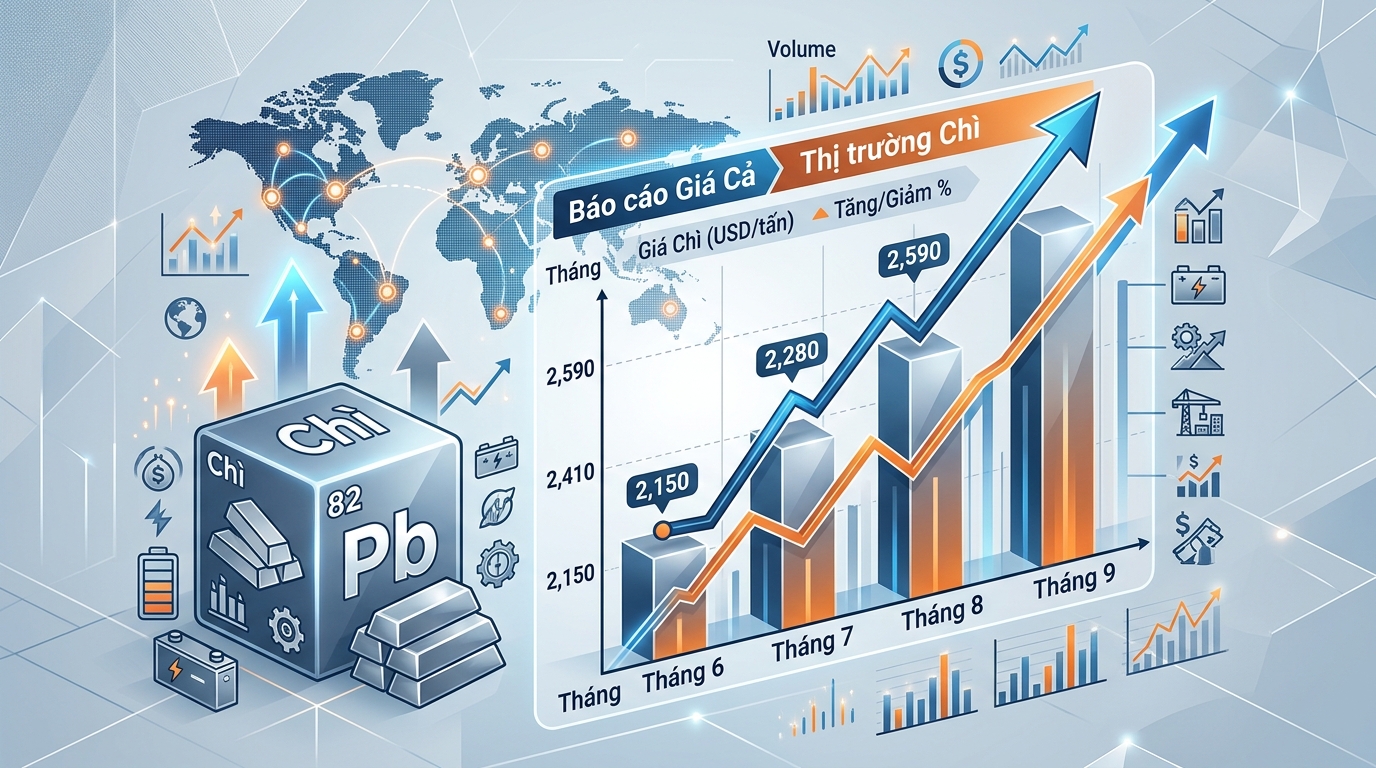
Welcome to our weekly non-ferrous metal market analysis. In this article, we will delve into the performance of the Lead (Lead) market in November 2026, specifically focusing on the first week of the month. The market is experiencing notable volatility, reflecting the complex interplay between internal supply-demand factors and a challenging global macroeconomic landscape.
Although Lead is not the "hottest" metal like Copper or Lithium in the energy transition wave, it continues to play an irreplaceable role in the traditional battery industry and various other technical applications. Therefore, understanding Lead price trends is essential for manufacturers, investors, and stakeholders across the supply chain.
Overview of Lead Price Performance in Vietnam and Globally
As of early November 2026, the global Lead market is recording a slight but clear downward trend. The current price on the London Metal Exchange (LME) is trading around the 1,886.40 USD/mt mark (updated on 03/11/2026). This price level reflects a decline from the beginning of the month, when the price opened at 1,911.60 USD/mt.
In the Vietnamese market, this price is equivalent to approximately 48,601,210 VND/ton. The fluctuation of domestic prices is primarily influenced directly by global prices and the USD/VND exchange rate. Despite a minor increase in the most recent day (+0.40 USD, equivalent to +0.02%), the general short-term trend remains downward, as evidenced by the continuous decline from 01/11 to 03/11.
For a more comprehensive overview, let us examine the key statistics:
- Current Price (03/11/2026): 1,886.40 USD/mt ≈ 48,601,210 VND/ton.
- Trend: Downward.
- Average Price for November (to date): 1,900.97 USD/mt ≈ 48,976,591 VND/ton.
- Average Price for October: 1,893.55 USD/mt ≈ 48,785,422 VND/ton.
- 30-day Price Range: 1,850.40 - 1,937.90 USD/mt.
The decline in early November follows a month where the average price in October recorded a slight increase compared to the previous month. This indicates that the market lacks a sustainable growth momentum and is vulnerable to negative news.
Analysis of Factors Driving Lead Price Volatility
The decline in Lead prices during the first days of November 2026 can be explained by a combination of several fundamental and technical factors.
1. Weakening Demand from the Battery Industry
The primary demand for Lead still comes from the lead-acid battery manufacturing industry, particularly in the automotive and motorcycle sectors. In China—the world's largest consumer of Lead—the strong shift toward electric vehicles (EVs) using Lithium-ion batteries is gradually shrinking the market share of lead-acid batteries in new vehicle models. Although lead batteries are still used for auxiliary functions (such as starting and lighting) in EVs, the amount of Lead consumed per vehicle is significantly lower.
Furthermore, industrial production data from major economies such as the Eurozone and the United States in October showed a slowdown, affecting the demand for battery replacements in the transport and heavy industry sectors.
2. Stable to Surplus Supply Conditions
In contrast to the weak demand, global Lead supply remains quite stable. Major mining operations and secondary Lead recycling plants have maintained their operating capacities. The increase in Lead recycling activity, partly due to stricter environmental regulations, has ensured a steady supply stream, even when primary ore supply may be constrained.
The combination of weak demand and stable supply has led to concerns about a surplus in the market, putting downward pressure on prices.
3. Technical Factors and Market Sentiment
After failing to break through key resistance levels in October, Lead prices faced profit-taking pressure from investors. The continuous decline in the first three days of November (from 1,911.60 USD to 1,886.40 USD) triggered technical sell orders, exacerbating the downward momentum.
Analysis of Macroeconomic Impacts on Lead Prices
Beyond internal supply and demand factors, Lead prices, like other base metals, are strongly influenced by the global macroeconomic environment.
1. US Federal Reserve (Fed) Monetary Policy and USD Strength
This is the most important macroeconomic factor affecting metal prices. Despite interest rate cuts in 2026, persistent inflation in the United States has led the Fed to maintain a cautious stance. Uncertainty regarding the future interest rate path has kept the US Dollar Index (DXY) at a relatively high level.
Since Lead is priced in USD on the LME, a strong USD makes the metal more expensive for buyers using other currencies, thereby reducing global demand. The decline in Lead prices in early November partly reflects the slight recovery of the USD.
2. China's Economic Growth and Stimulus Measures
As the leading consumer of metals, China's economic health has a direct impact on Lead prices. Throughout 2026, the Chinese government has launched numerous economic stimulus measures, focusing on infrastructure and real estate. However, the effectiveness of these measures remains a major question. China's manufacturing PMI data in October remained near the 50-point threshold, indicating that the recovery is not yet truly solid.
The market is concerned that if stimulus measures do not yield expected results, demand for base metals, including Lead, will continue to weaken.
3. Geopolitical Risks and Supply Chains
Although not directly impacting major Lead-producing regions, prolonged geopolitical conflicts in the Middle East and Eastern Europe continue to create instability for global supply chains and energy costs. High energy costs can increase the cost of Lead production, especially during the smelting process, creating a floor for metal prices.
However, in the current context of weak demand, the energy cost factor is not strong enough to push Lead prices up, but it does play a role in preventing a deeper price collapse.
Outlook and Price Forecast for the Remainder of November 2026
Based on the above analysis, we believe that Lead prices for the remainder of November 2026 will continue to face downward pressure. The current price (1,886.40 USD/mt) is approaching the low end of the 30-day range (1,850.40 USD/mt). This will be a critical technical support level.
If Lead prices break below the 1,850 USD/mt support level, the decline could accelerate toward the 1,800 USD/mt threshold. Conversely, for a significant recovery, the market needs to see more positive signals from Chinese economic data or a significantly weaker USD.
For businesses in Vietnam, the decline in global prices may provide some relief regarding input material costs. However, the volatility of the USD/VND exchange rate should be closely monitored, as it could offset part of the advantage gained from lower metal prices.
Recommendation: Lead-consuming businesses should consider a cautious purchasing strategy, taking advantage of deep price dips to stock up on a portion of necessary inventory, but should not "bottom fish" too early while the downward trend remains strong. Closely monitoring information regarding Fed policy and Chinese economic data is extremely important.
We will continue to update the latest developments in the Lead market in our upcoming reports. Thank you for your interest and for following our analysis.