 Deutsch
 English
 Español
 Français
 Bahasa Indonesia
 日本語
 한국어
 Nederlands
 Português
 Tiếng Việt
 中文
Commodity Market Analysis Report for the Week of October 12, 2026 - October 18, 2026
AI Market Digest
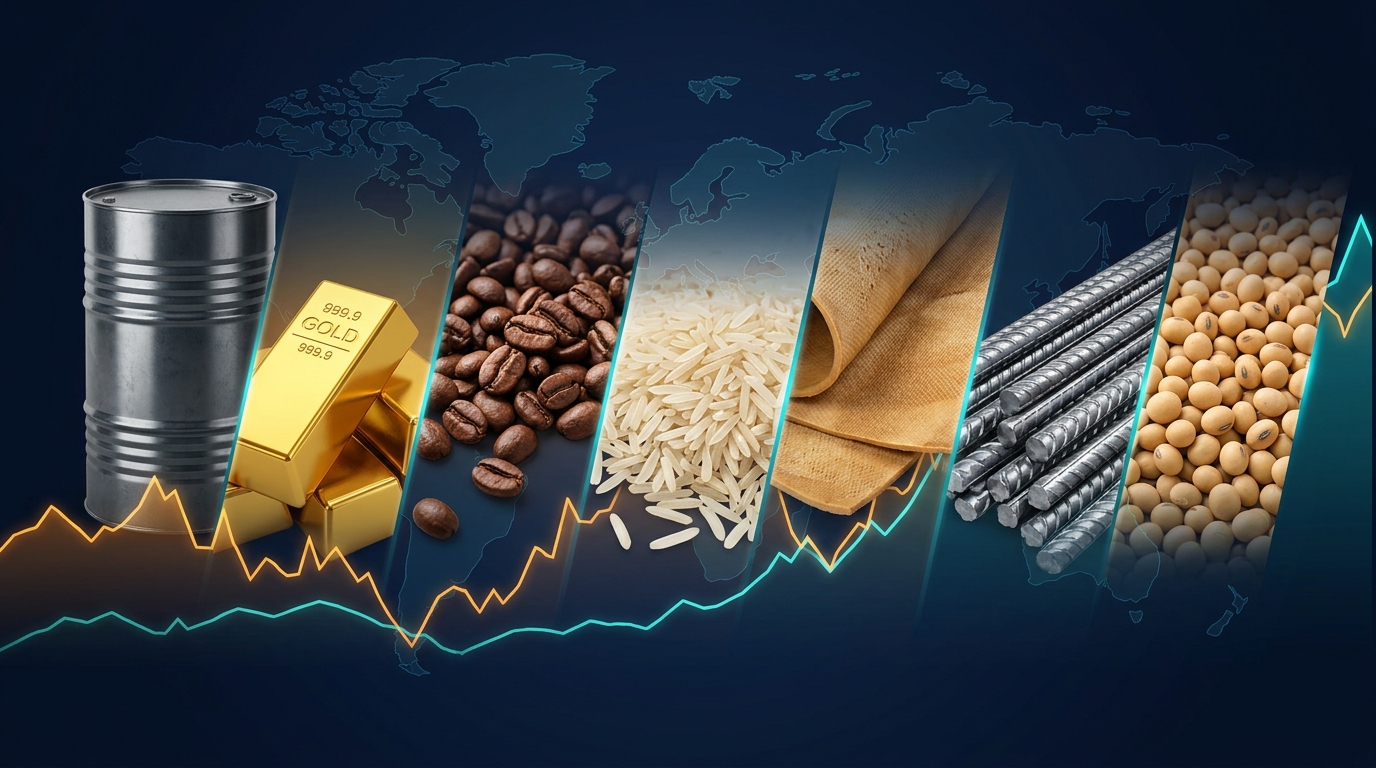
The commodity market for the week of October 12, 2026 - October 18, 2026, recorded a strong divergence across sectors amidst global geopolitical instability. Rising geopolitical pressure in Europe, coupled with aid-related tensions concerning Ukraine, the wave of social unrest in France, and internal political fractures in the U.S. ahead of the elections, have fueled safe-haven demand. This has kept gold prices anchored at record levels and pushed Brent crude oil prices to surge. Meanwhile, industrial commodities faced pressure from a sluggish global economic growth outlook, while the agricultural market remained in a tug-of-war, dominated by input material costs.
Agricultural Products
Global agricultural prices for the week of October 12 to October 18 generally maintained a stable to slightly upward trend, highlighted by the rise in the fertilizer group. Urea fertilizer recorded a significant increase of 2.62% on October 14, 2026, to 450.00 USD/ton (equivalent to 11,652,525 VND/ton), exceeding the monthly average of 439.54 USD/ton. DAP fertilizer held at 802.50 USD/ton (equivalent to 20,780,336 VND/ton). The upward price movement of fertilizers continues to reflect pressure from rising energy raw material costs in Europe and the Middle East.
The coffee and rubber markets maintained a sideways trend within a narrow range as supply is in a seasonal transition period. Robusta coffee anchored at 3,414.00 UScents/kg (equivalent to 884,038,230 VND/ton, up 0.06%), slightly lower than the monthly average of 3,460.17 UScents/kg. Arabica coffee stabilized at 305.60 UScents/lb (approximately 174,459,707 VND/ton). Natural rubber closed the week at 259.50 JPY/kg (approximately 56,788,980 VND/ton, up 0.19%), while TSR20 rubber adjusted slightly downward by 1.13% to 261.50 USD/kg.
The rice and grain markets recorded abundant supply, which curbed price increases. Vietnam's 5% broken rice held a reference price of 418.50 USD/ton (approximately 10,836,848 VND/ton), maintaining a significant competitive advantage over Thai 5% rice, which is at 482.00 USD/ton. Soybeans and corn fluctuated slightly around 1,261.25 UScents/bushel (+0.04%) and 474.25 UScents/bushel (+0.11%). Notably, Vietnam's deeply processed agricultural products, such as Tay Ninh rice paper, are expanding strongly into demanding markets (South Korea, the U.S., EU), reflecting a trend of increasing surplus value rather than relying solely on raw agricultural exports.
Outlook for next week: The agricultural group is expected to continue its divergence. Fertilizer prices may maintain a slight upward trend following energy prices, putting cost pressure on farmers preparing for the new crop in the Central Highlands and the Mekong Delta; meanwhile, coffee and rice prices will likely maintain a consolidation phase around current price levels.
Metals
Precious metals continued to assert their position as an optimal safe-haven channel as global gold prices touched 4,177.19 USD/ounce on October 18, 2026. This price is equivalent to approximately 130,410,541 VND/tael, up 0.02% in the final session of the week and remaining higher than the monthly average (4,158.34 USD/ounce). Silver prices also held high at 57.34 USD/ounce (+0.06%), while platinum traded at 1,648.90 USD/ounce. Political instability in the U.S. along with prolonged geopolitical conflicts in the NATO - Eastern Europe region are the direct drivers supporting the precious metals group.
In contrast to precious metals, the base industrial metals group faced adjustment pressure due to concerns over weakening manufacturing demand. Aluminum prices fell 1.25% to 2,981.90 USD/ton (approximately 77,214,810 VND/ton), significantly lower than the monthly average of 3,083.03 USD/ton. Zinc fell 0.73% to 3,724.20 USD/ton and nickel fell 0.63% to 15,529.00 USD/ton. Tin bucked the trend, rising 0.62% to 51,767.00 USD/ton (approximately 1,340,480,582 VND/ton) thanks to strong demand from the global semiconductor and electronics industry, where major corporations like Samsung continue to expand supply chain cooperation in Vietnam.
62% Fe Iron Ore closed the week at 91.35 USD/dmtu (+0.11%), reflecting that construction and real estate activity in China is still in a slow recovery phase.
Outlook for next week: Precious metals are likely to continue consolidating at peak levels with an upward bias if statements from U.S. political officials continue to disrupt the market. Industrial metals are likely to retest the nearest support levels.
Energy
Brent crude oil led the energy group's gains this week, rising sharply by 3.10% to 109.59 USD/barrel (equivalent to 2,837,778 VND/barrel). This figure far exceeds the monthly average of 103.41 USD/barrel. Dubai crude also remained in the high range at 109.45 USD/barrel (+0.82%). Conversely, WTI crude recorded a slight divergence, adjusting down 0.15% to 98.26 USD/barrel due to an increase in U.S. domestic inventories.
Geopolitical tensions and concerns over maritime route disruptions are the main catalysts pushing Brent oil prices higher. Calls for increased budget support for Ukraine from NATO member countries and social unrest in France have triggered defensive sentiment regarding the risk of supply disruptions from Russia and the Middle East. In line with crude oil, coal traded at 150.40 USD/ton (+1.04%) and Japanese LNG rose 1.12% to 26.27 USD/mmbtu as Asian countries actively stockpile fuel for the approaching winter.
Natural gas in the U.S. closed the week at 3.05 USD/mmbtu (-0.13%), relatively stable compared to the monthly average (3.14 USD/mmbtu) thanks to abundant shale gas supply.
Outlook for next week: The global crude oil market will continue to maintain a high geopolitical risk premium. Brent oil prices are likely to test the 112 - 115 USD/barrel mark if international diplomatic tensions show no signs of cooling down.
Food
The international meat market recorded very clear mixed movements between pork and other types of livestock and poultry meat. Pork prices plummeted by 9.48% on October 14, 2026, falling to 68.03 UScents/lb (equivalent to 38,833,840 VND/ton), significantly lower than the monthly average of 76.10 UScents/lb. This sudden decline stems from abundant export pork supply from large-scale industrial farms, while consumer purchasing power in developed markets has tightened.
Conversely, poultry and beef continued their slight upward trend to offset feed costs. Chicken rose 1.19% to 8.51 BRL/kg (approximately 35,157,533 VND/ton) and beef rose 0.58% to 380.20 BRL/kg (equivalent to 1,570,727,864 VND/ton). For Vietnam, the decline in international pork prices may reduce the pressure of frozen meat imports, supporting domestic farmers in maintaining market share in preparation for the peak year-end consumption season.
Outlook for next week: Pork prices tend to form a technical bottom after the sharp sell-off, while poultry and beef will maintain a slight upward trend following energy price fluctuations and logistics costs.
Notable Commodity Movements of the Week
- Brent Crude Oil (up 3.10% to 109.59 USD/barrel): Broke through short-term peaks due to the cumulative impact of Eastern European geopolitical tensions, concerns over defense aid, and political instability in Europe, increasing the risk of energy transport chain disruptions.
- Pork (down 9.48% to 68.03 UScents/lb): The sharpest price slide in the commodity market this past week due to short-term supply-demand imbalances and selling pressure in large-scale production markets.
- Urea Fertilizer (up 2.62% to 450.00 USD/ton): Continued to accelerate, directly reflecting the surge in raw gas and global crude oil prices, posing challenges for winter-spring crop costs in Asia.
- Gold (anchored at 4,177.19 USD/ounce): Maintained historical price levels above 130 million VND/tael as global investors increased their search for assets to protect against internal U.S. political fractures and the risk of escalating conflict in Europe.
Forecast and Recommendations for the Week of October 19, 2026 - October 25, 2026
The commodity market next week is expected to continue to be closely governed by diplomatic developments and macroeconomic data. Businesses and investors need to prepare response scenarios for each sector:
- Energy Group: Forecast to maintain an upward trend or anchor at high levels. Transport and manufacturing businesses in Vietnam that are heavily dependent on gasoline and oil should proactively use derivative contracts or lock in import prices to minimize price volatility risks.
- Agricultural and Fertilizer Group: Fertilizer is forecast to maintain high levels above 440 - 450 USD/ton. Domestic agricultural businesses need to actively optimize inventory and regulate winter crop cultivation costs. For rice, the price of 418.50 USD/ton still provides a competitive export advantage for Vietnam to African and Southeast Asian markets.
- Metals Group: Gold may continue to fluctuate within a large range around 4,150 - 4,200 USD/ounce. For non-ferrous metals, mechanical and construction production units should be cautious in stockpiling aluminum and zinc as global production indices have not shown clear signs of a breakthrough.
Key risk factors to monitor: Political security developments in the U.S. ahead of the midterm elections; military moves and new aid packages from the NATO bloc for the Ukraine battlefield; inflation indices and global stock market liquidity; as well as seasonal weather conditions directly affecting the agricultural harvest cycle in Southeast Asia.
Share this insight: