 Deutsch
  English
  Español
  Français
  Bahasa Indonesia
  日本語
日本語  한국어
한국어  Nederlands
  Português
  Tiếng Việt
  中文
中文 Commodity Market Summary Report for the Week of August 17, 2026 - August 23, 2026
AI Market Digest
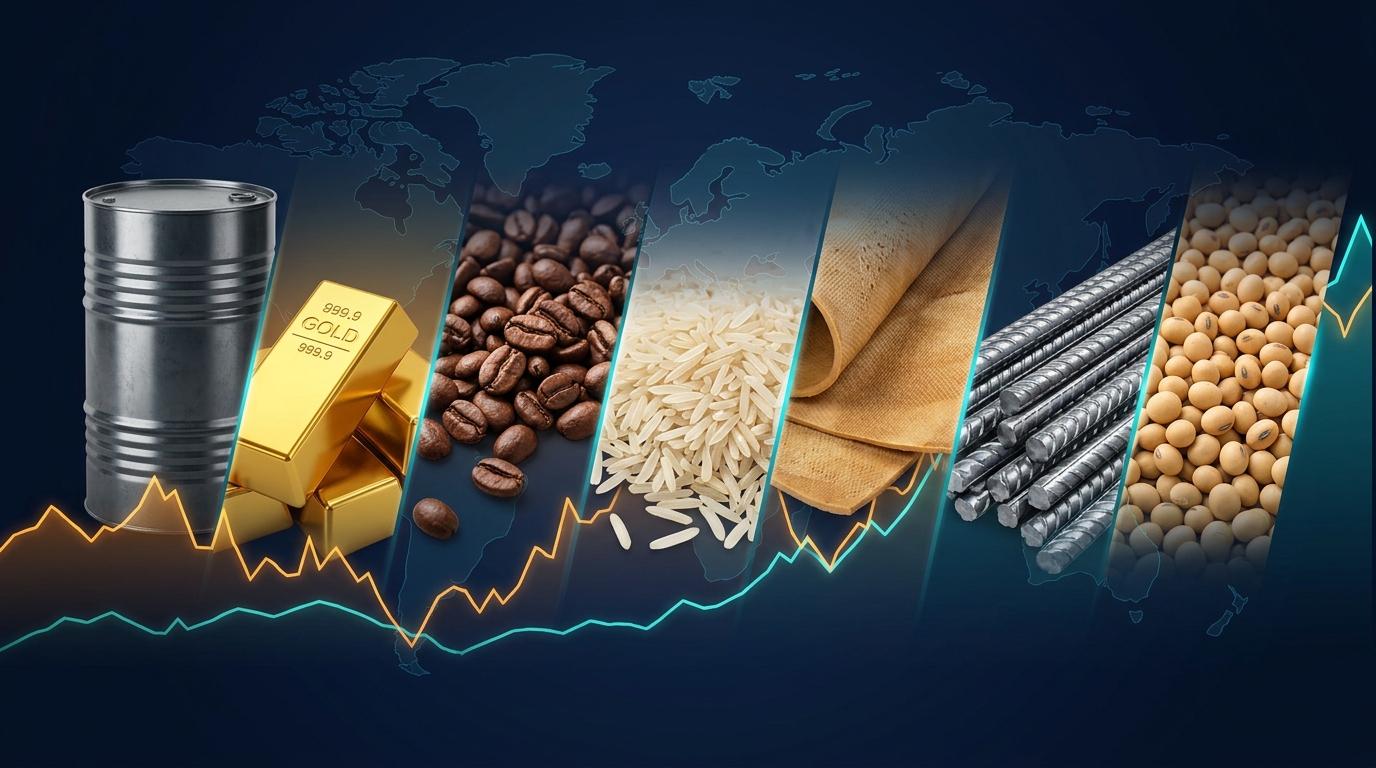
The global commodity market during the week of August 17 to August 23, 2026, recorded complex fluctuations under pressure from U.S. public debt and escalating geopolitical tensions in the Middle East and Eastern Europe. Against the backdrop of U.S. public debt exceeding the $40,000 billion threshold, which has sparked concerns regarding global financial stability, the prices of strategic commodities such as gold, crude oil, and agricultural products have tended to remain at high levels or increase slightly. Notably, Iran's declaration of its readiness to attack oil and gas export routes and the heavy presence of NATO aircraft near the Russia-Belarus border have created a significant "risk premium" on energy and precious metal prices.
GROUP: Agricultural Products
Prices for key agricultural commodities recorded a uniform increase, led by grains and rubber due to concerns over supply disruptions in Southeast Asia and Eastern Europe.
- Rubber: Closed the week at 231.10 JPY/kg (approximately 50,573,924 VND/ton), up 1.27%. Riots, bombings, and arson in Thailand—a leading rubber exporter—have raised concerns regarding harvesting and transportation capabilities, pushing prices above the monthly average (221.46 JPY).
- Rice (US): Recorded the strongest growth in the group at +3.93%, reaching 14.70 USD/CWT (approximately 7,677,991 VND/ton). Instability in key agricultural regions and rising logistics costs due to geopolitical risks are the primary causes.
- Arabica Coffee: Continued to maintain a very high level of 322.65 UScents/lb (approximately 185,829,182 VND/ton), an increase of 2.02% compared to the previous week. Consumption demand remains stable while supply from major exporting countries has yet to be fully cleared.
- Corn and Soybeans: Increased slightly by 1.04% (reaching 483.75 UScents/bu) and 0.35% (reaching 1,225.00 UScents/bu), respectively. News that Ukraine received a $9 billion aid package may provide some support for the recovery of agricultural production in the country, but conflicts within the Ukrainian military leadership remain a potential risk factor for the Black Sea grain corridor.
Trend Outlook: In the coming week, agricultural prices may continue to anchor at high levels if the security situation in Thailand does not stabilize soon. For the Vietnamese market, rice and rubber exporters should closely monitor developments in Thailand to adjust their offering prices.
GROUP: Metals
Precious metals maintained their status as safe-haven assets, while industrial metals grew on expectations of major infrastructure projects.
- Gold: Closed the week at 4,607.40 USD/toz (equivalent to 145,119,294 VND/tael). Although it only rose by 0.01%, it remains at a record high due to investors' "chilling" sentiment regarding the $40,000 billion U.S. public debt figure.
- Platinum: Surged by 3.08%, reaching 1,895.70 USD/toz. This was the best-performing commodity in the metals group this week, far exceeding the monthly average of 1,382.31 USD due to demand in green technology and shifts in investment capital flows.
- Aluminum and Zinc: Recorded increases of 1.92% and 1.99%, respectively. In Vietnam, the implementation of major infrastructure projects, such as the trillion-dong pedestrian bridge across the Saigon River or resettlement projects in Hanoi, is boosting domestic demand for base metals.
- Copper: Increased by 0.19%, reaching 657.95 UScents/lb, reflecting the slow but steady recovery of the global industrial manufacturing sector.
Trend Outlook: Gold prices are forecast to remain volatile depending on statements from the FED regarding the interest rate path (currently, interest rates at Vietnamese banks such as Agribank and Vietcombank are being closely monitored). Industrial metals will maintain a slight upward trend thanks to public investment packages.
GROUP: Energy
The energy market heated up following direct threats from Iran against international oil export routes.
- Brent Crude Oil: Increased by 0.65%, reaching 94.39 USD/bbl (approximately 2,465,892 VND/barrel). This price is significantly higher than the monthly average (87.78 USD) due to concerns regarding the Strait of Hormuz following Iran's statement.
- WTI Crude Oil: Increased by 0.26%, reaching 87.06 USD/bbl. The presence of NATO aircraft near Russia and Belarus also contributed to the rise in oil prices due to fears that direct conflict could affect supply from this region.
- US Natural Gas: Increased by 1.46%, reaching 2.77 USD/mmbtu due to stockpiling demand for the upcoming peak season.
- Coal: Increased by 0.77%, reaching 131.50 USD/mt. Russia is striving to surpass the U.S. and Belgium in the energy sector in 2026, creating fierce competition for market share in coal and gas exports.
Trend Outlook: Oil prices carry the risk of spiking to the $100 threshold if tensions in the Middle East escalate into actual military action. Transportation businesses in Vietnam need to have fuel price hedging plans in place.
GROUP: Food
Global food prices fluctuated slightly, influenced by logistics costs and animal feed.
- Beef: Reached 343.20 BRL/kg, up 0.72%. Despite a slight weekly increase, it remains lower than the monthly average (346.44 BRL).
- Pork: Increased by 0.81%, reaching 80.88 USD/lbs. In the domestic market, food demand is stable, but incidents blocking access to farmland in some localities like Ninh Bình could locally affect the short-term supply of agricultural food products.
- Chicken: Increased by 0.84%, reaching 7.24 BRL/kg.
Trend Outlook: The food group is expected to be more stable compared to other sectors as global supply is currently sufficient to meet existing demand.
Most Notable Commodities of the Week
Over the past week, Rice (US) and Platinum were the two most notable commodities, with increases of 3.93% and 3.08%, respectively. The direct causes stem from political instability in key supply regions (Thailand for agricultural products) and the shift of capital flows toward precious metals with high industrial applications amid the monetary instability caused by U.S. public debt.
Forecast and Recommendations for the Coming Week (August 24, 2026 - August 30, 2026)
Trend Forecast:
- Energy: Continued upward trend (Bullish) due to geopolitical risks from Iran and Russia.
- Precious Metals: Sideways at a high level (Side-way up) as investors await clearer signals regarding U.S. public debt and bank interest rates.
- Agricultural Products: Divergent; rubber and rice may continue to rise, while corn and soybeans depend on the progression of the war in Ukraine.
Risk Recommendations:
- Geopolitical Risk: Closely monitor the Strait of Hormuz and the Russia-Belarus border. Any military clash will cause extreme volatility in oil and gold prices.
- Financial Policy: Monitor reports on U.S. public debt and inflation, as these will directly impact the strength of the USD and the price of USD-denominated commodities.
- Vietnam Market: Businesses need to pay attention to domestic bank interest rate fluctuations to optimize the cost of capital for raw material import activities. Investing in electric vehicle lines (such as the newly launched electric Ninja model) or fuel-efficient vehicles may be a long-term trend as fossil fuel energy prices remain unstable.
Share this insight: