 Deutsch
  English
  Español
  Français
  Bahasa Indonesia
  日本語
日本語  한국어
한국어  Nederlands
  Português
  Tiếng Việt
  中文
中文 Commodity Market Summary Report for the Week of 03/08/2026 - 09/08/2026
AI Market Digest
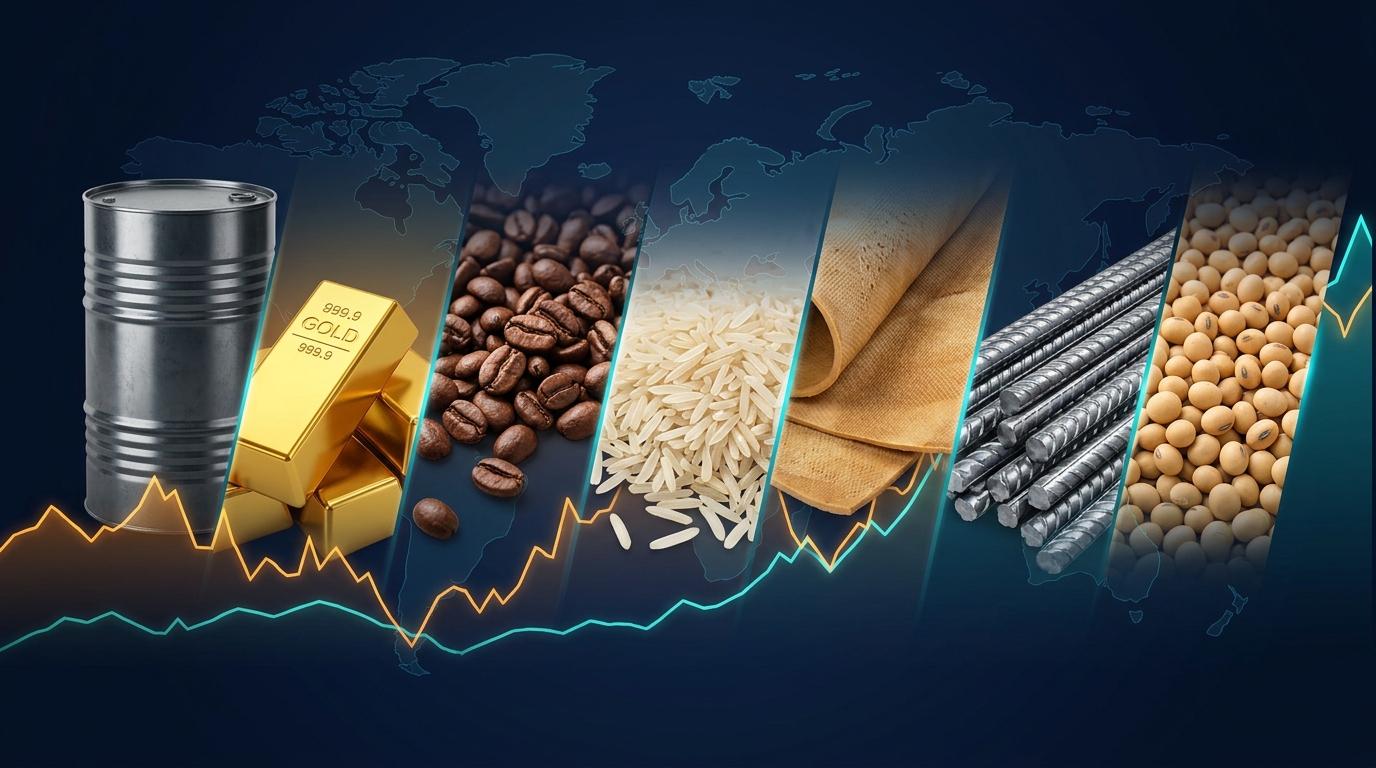
The commodity market over the past week (03/08 - 09/08/2026) witnessed complex fluctuations driven by intense geopolitical risks in the Middle East and a severe shortage of high-skilled technical labor in Russia. The market's focus centered on Iran's declaration regarding the potential "closure" of the Strait of Hormuz—one of the world's most vital maritime arteries—directly threatening global energy and agricultural supply chains. Meanwhile, in the Vietnamese market, news regarding inspections of gold businesses and bank interest rate policies is fostering a cautious sentiment among investors.
GROUP: Agricultural Products
Sugar and Arabica Coffee prices led the gains in the agricultural sector last week due to concerns over maritime transport disruptions. Specifically, Sugar prices closed on 09/08 at 16.45 UScents/lb, a sharp increase of 5.65% compared to the monthly average. The primary cause stems from tensions in the Strait of Hormuz, where Iran has threatened a blockade, putting pressure on international trade routes. Arabica Coffee also recorded a 3.2% increase, reaching 315.90 UScents/lb (equivalent to approximately 182,495,212 VND/ton), indicating that logistics cost pressures are gradually being reflected in product prices.
- Rubber: Traded at 218.80 JPY/kg, up slightly by 0.55%, maintaining stability thanks to demand from the automotive industry.
- Rice: International rice prices stood at 14.23 USD/CWT, an increase of only 0.32%. In Vietnam, the market is awaiting new developments from major infrastructure projects, such as those in Quang Ninh, to forecast domestic consumption demand.
- Soybeans and Corn: Fluctuations were negligible, at 1,156.50 UScents/bu (+0.06%) and 439.00 UScents/bu (0%) respectively, reflecting that supply from the US and South American regions is still meeting current demand.
Forecast for next week: The agricultural group will continue to be influenced by news of the conflicts in Ukraine and the Middle East. If the Strait of Hormuz is effectively blockaded, prices for key export commodities could escalate further due to soaring insurance and transport costs.
GROUP: Metals
Global Gold prices maintained a record level of 4,343.40 USD/toz amidst rising geopolitical instability. Although it only rose by 0.01% during the week, the price—equivalent to 137,220,396 VND/tael—shows that this precious metal remains the number one safe-haven asset as Israel-Iran tensions escalate. In Vietnam, gold businesses are facing government inspections aimed at clarifying violations, which may cause a temporary decline in liquidity in the domestic gold bar market.
- Silver: Recorded an impressive increase of 3.32%, reaching 63.54 USD/toz, following the same trend as gold but with higher volatility.
- Zinc and Nickel: Increased by 1.71% (3,697.30 USD/mt) and 1.5% (16,970.00 USD/mt) respectively. The shortage of high-skilled welders in Russia (with salaries surging to 174-200 million VND/month) is indirectly affecting mining operations and metal infrastructure maintenance in this region.
- Platinum: Increased by 1.25%, reaching 1,759.60 USD/toz, indicating that industrial demand is still recovering steadily.
Forecast for next week: Prices for base and precious metals will depend heavily on bank interest rate decisions in Vietnam (currently being updated at major banks such as Agribank and Vietcombank) and military developments in the Middle East.
GROUP: Energy
Brent and WTI crude oil prices simultaneously rose by over 1% due to the specter of conflict in the Strait of Hormuz. Ending the 09/08 session, Brent oil reached 83.55 USD/bbl (+1.05%) and WTI reached 78.18 USD/bbl (+1.15%). Iran's determination to force the US to meet its conditions by threatening to cut off the world's most important oil and gas transport route immediately pushed risk premiums into oil prices.
- US Natural Gas: Increased by 2.06%, reaching 2.66 USD/mmbtu. This is a notable increase as businesses begin to account for heating and storage needs for the upcoming period.
- Coal: Increased slightly by 0.31%, reaching 127.85 USD/mt, reflecting that thermal power demand remains stable in developing countries.
Forecast for next week: The energy market will be extremely sensitive to any military moves by Israel targeting Iran. An independent military campaign from Israel could quickly push Brent oil prices past the 90 USD/bbl mark.
GROUP: Food
The food market maintained a stable state with low volatility of under 0.5%. Beef traded at 347.50 BRL/kg (+0.23%), while chicken increased by 0.42% to 7.18 BRL/kg. Pork remained flat at 95.50 USD/lbs. In the Vietnamese market, the stability of the food group is a positive signal for the CPI, although risks regarding transport costs from global news may impact the import prices of animal feed ingredients in the medium term.
Most notable commodities of the week
- Sugar (+5.65%): The strongest gainer of the week due to concerns over global supply chain disruptions from geopolitical tensions.
- Silver (+3.32%): Attracted speculative capital as gold remained at excessively high price levels.
- Arabica Coffee (+3.2%): Continued its upward trend due to logistics costs and weather conditions in key growing regions.
Forecast and recommendations for next week (10/08/2026 - 16/08/2026)
Trend forecast: The commodity market next week will remain in a state of "red alert" regarding geopolitics. The Energy and Precious Metals groups will continue to dominate price gains. The Agricultural group may face slight profit-taking pressure but will maintain a high price floor due to transport costs.
Risk factors to monitor:
- Strait of Hormuz tensions: Any actual action to restrict vessel passage will cause global price shocks.
- Policies in Vietnam: Decree 296/2026/ND-CP regarding the prohibition of proxy capital contributions in businesses and new regulations on state capital will affect investment flows into commodity production and trading enterprises.
- Russian labor market: The shortage of technical personnel (welders) could disrupt metal and energy supplies from this country.
Recommendation: Businesses importing raw materials (sugar, grains) should consider locking in contracts early to avoid risks from exchange rate fluctuations and shipping fees. Individual investors should be cautious with domestic gold while inspections are strictly underway and may consider shifting toward industrial metal commodities with high liquidity on the commodity exchange.
Share this insight: