 Deutsch
  English
  Español
  Français
  Bahasa Indonesia
  日本語
日本語  한국어
한국어  Nederlands
  Português
  Tiếng Việt
  中文
中文 Commodity Market Summary Report for the week of 27/07/2026 - 02/08/2026
AI Market Digest
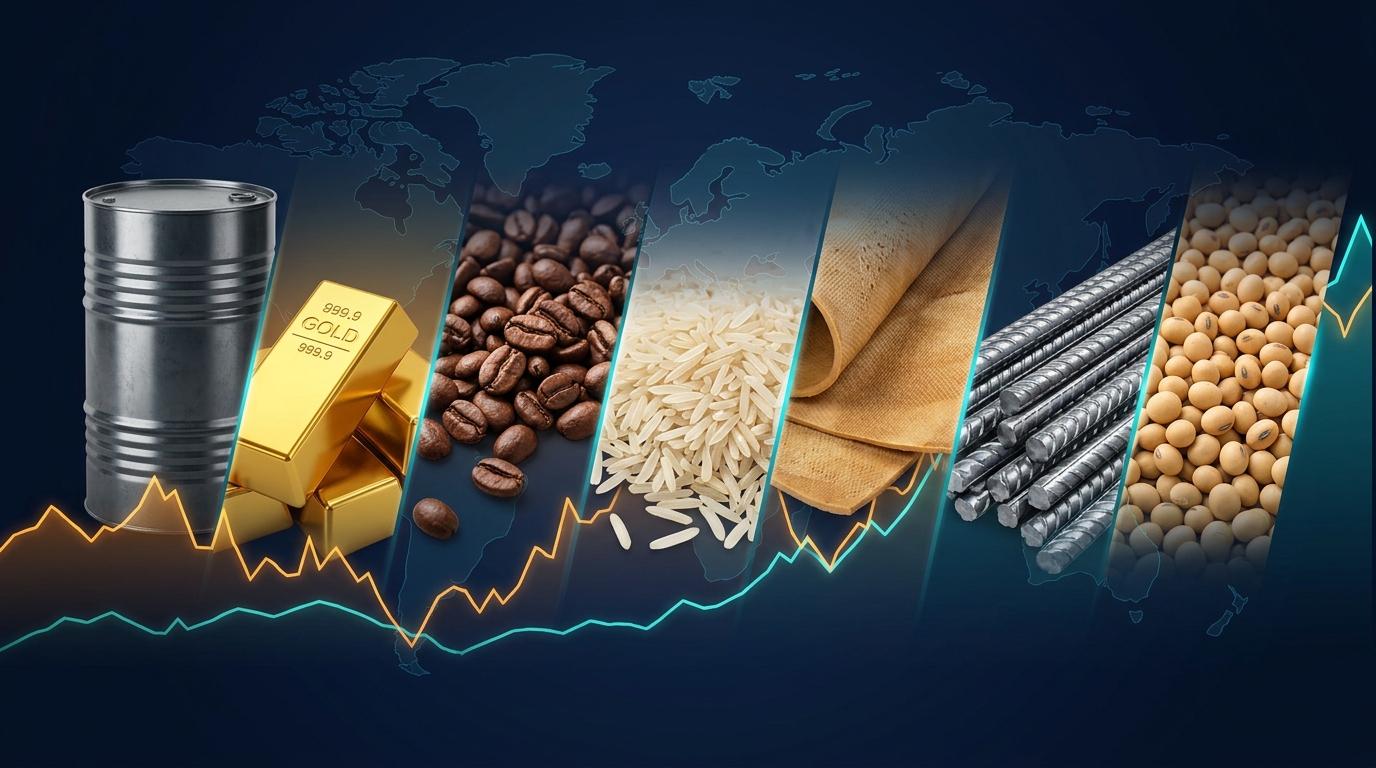
The global commodity market in the week from 27/07 to 02/08/2026 recorded a widespread growth trend across most key sectors amidst geopolitical tensions and a wait-and-see sentiment regarding monetary policies. The US Federal Reserve's (Fed) decision to keep interest rates unchanged has had multidimensional impacts on the stock and commodity markets in Vietnam. Notably, conflicts in the Black Sea region between Russia and Ukraine, including attacks on oil refineries and the port of Odessa, have become the primary drivers pushing energy prices and strategic agricultural commodities higher.
SECTOR: Energy
Global crude oil prices maintained a steady upward momentum of over 1% last week due to concerns over supply disruptions in Eastern Europe. Specifically, Brent crude closed the week at 87.93 USD/bbl (up 1.21%), while WTI crude reached 84.67 USD/bbl (up 1.29%).
- Causes: Reports of Ukraine striking bomber bases and attacking major Russian oil refineries have directly pushed supply risk premiums higher. Furthermore, the war situation in Odessa and signals regarding potential Russian military landings have made energy transport corridors through the Black Sea precarious.
- Natural Gas and Coal: US Natural Gas rose slightly by 0.4% to 2.75 USD/mmbtu. Coal remained stable at 134.00 USD/mt (+0.04%) amidst high electricity demand for the summer season.
- Outlook for next week: Energy prices may continue to fluctuate strongly if attacks on Russian oil and gas infrastructure persist. Investors should closely monitor moves from OPEC+ in light of these new developments.
SECTOR: Agriculture
The agricultural market witnessed a strong breakthrough in coffee and rubber thanks to support from logistics factors and recovering demand. Arabica coffee was the most impressive performer in the group with a 2.8% increase, reaching 332.10 UScents/lb (equivalent to approximately 192.5 million VND/ton).
- Price fluctuations: Rubber reached 216.30 JPY/kg (+1.31%), sugar rose 1.59% to 14.66 UScents/lb. Cereal commodities such as Corn (+1.12%, reaching 440.75 UScents/bu) and Soybeans (+0.45%, reaching 1,172.00 UScents/bu) also recorded gains.
- Causes: Transport disruptions at major seaports due to the Russia-Ukraine conflict have increased global logistics costs. In Vietnam, the Fed's decision to keep interest rates unchanged has helped stabilize the exchange rate, supporting agricultural exports. However, rising bank non-performing loan risks (according to financial news on 03/08) could affect credit flow for domestic agricultural purchasing enterprises.
- Outlook for next week: The upward trend may slow down as the market has absorbed the geopolitical news. Coffee prices remain anchored at high levels due to long-term supply concerns.
SECTOR: Metals
Gold continues to affirm its role as a safe-haven asset by surpassing the 4,000 USD/toz threshold amidst global instability. Global gold prices closed the week at 4,043.00 USD/toz, up 1.47%, equivalent to approximately 128.17 million VND/tael.
- Precious metals: Silver recorded a strong increase of 2.35%, reaching 57.62 USD/toz. The fact that the Fed has not cut interest rates but has provided cautious signals has caused investors to shift capital from risky assets to precious metals.
- Industrial metals: This group showed mixed performance. Nickel rose 0.35% to 17,255.00 USD/mt, Zinc rose 0.77% to 3,645.50 USD/mt. Conversely, Copper recorded a downward trend (to 0.00 UScents/lb in weekend update data) due to concerns about the economic growth rate of China – the world's largest consumer of copper.
- Outlook for next week: Gold prices are likely to undergo a technical correction after hitting a peak, but the general trend remains upward if tensions in Ukraine and the Middle East do not cool down.
SECTOR: Food
Food prices maintained a stable state with a narrow fluctuation range of less than 0.5%. The pork and poultry markets did not see significant price surprises last week.
- Price details: Pork rose 0.43% to 98.85 USD/lbs. Beef and chicken in the Brazilian market (BRL) rose slightly by 0.1% and 0.14%, respectively.
- Context: In the domestic Vietnamese market, attention has focused on legal issues and penalties in the pharmaceutical industry (the case at Cuu Long Pharmaceutical - DCL) and regulations on traffic safety and traffic fines; this indirectly affects general consumer sentiment but has not directly impacted raw food prices.
- Outlook for next week: Food prices are expected to remain flat. Global food supply remains sufficient to meet short-term demand.
Most notable commodities of the week
Arabica Coffee (+2.8%) and Silver (+2.35%) were the two commodities with the most prominent growth. The rise in coffee prices reflects concerns about tightened supply chains due to the impact of attacks on seaports in Ukraine, while Silver rose following Gold's momentum as investors sought safety against geopolitical risks from Russia and its allies.
Forecast and recommendations for next week (03/08/2026 - 09/08/2026)
Trend forecast:
- Energy: Expected to remain at high levels. Investors should pay special attention to news regarding Russia's response to Ukraine's attacks on energy infrastructure.
- Agriculture: Rice and coffee prices may face profit-taking pressure. However, rubber prices may increase further due to recovering demand from the automotive industry.
- Metals: Gold will face strong resistance around the 4,100 USD zone. If there is more bad news regarding bank non-performing loans or recession, gold will continue to break records.
Risk recommendations:
- Geopolitical risk: The Russia-Ukraine conflict is entering a new phase with deep strikes into enemy territory, which could cause supply shocks at any time.
- Financial risk: Closely monitor the situation of bank non-performing loans in Vietnam and subsequent Fed decisions to adjust commodity portfolios accordingly.
- Policy risk: New regulations on penalties and market control (such as Decree 168 mentioned in the news) may affect the operating costs of food logistics businesses.
Dit inzicht delen: